

 Set as a preferred Google source
TL;DR
- Compliance obligations in outsourcing did not change when seats went remote. The place where they have to be enforced did, moving from a controlled floor to uncontrolled rooms.
- Network and access controls cannot see the two biggest residual risks in a remote seat, which are visual exposure of the screen and capture of data by a second device.
- Seven seat level controls carry most of the weight, covering identity, environment, screen exposure, transfer restriction, location assurance, evidence capture and automated response.
- Detection has no compliance value on its own. Value comes from the chain of detect, prevent, alert, evidence, remediate and govern, because clients audit the chain and not the alert.
- Seat level monitoring is defensible only with purpose limitation, role-based access, retention limits and clear employee communication agreed before go live.
A collections agent signs in from a bedroom in a shared flat at seven in the morning. The VPN connects, the client CRM opens and a screen full of cardholder records appears. For the next eight hours every system log will read as compliant. Not one of them will record that a flatmate walked behind the monitor twice, or that a phone sat propped against a water bottle with the camera pointed at the screen.
That is the gap outsourced delivery now lives with. Access controls prove the right credentials were used. They say nothing about the room the work is happening in, and the room is where most client data is actually lost.
BPO compliance software is the category built to close that gap. It moves the control point away from the network edge and down to the agent seat, so a provider can both prevent exposure and produce evidence that the control was running when a client or an auditor asks. The same shift is what makes insider threat prevention workable at scale, because supervisors can no longer walk a floor that is spread across hundreds of homes.
This guide sets out what the category covers, which obligations it has to satisfy, the seven controls that matter at the seat, and how those controls become audit ready evidence rather than a dashboard nobody reviews.
What Is BPO Compliance Software
BPO compliance software is a platform that enforces, monitors and evidences the data protection obligations a service provider owes its clients at the point where the work happens, which is the agent seat. It combines identity verification, workspace and screen controls, policy enforcement and tamper resistant event records, so a provider can stop an exposure and then prove the control was operating when it mattered.
What It Covers Beyond Call Recording
Most providers already own call recording, quality monitoring and a ticketing trail. Those tools describe the conversation. They do not describe the environment the conversation took place in. Compliance software for outsourced delivery adds the layer underneath, covering who was physically at the desk, who else could see the screen, whether a recording device was present, whether data could be copied out, and whether the agent was working from an approved location on an approved network.
The distinction matters commercially. Client security questionnaires have moved past asking whether calls are recorded. They now ask how the provider prevents an unauthorised person from viewing customer information on a home screen, and what evidence exists that the answer is true on any given day.
Why The Remote Seat Changed The Requirement
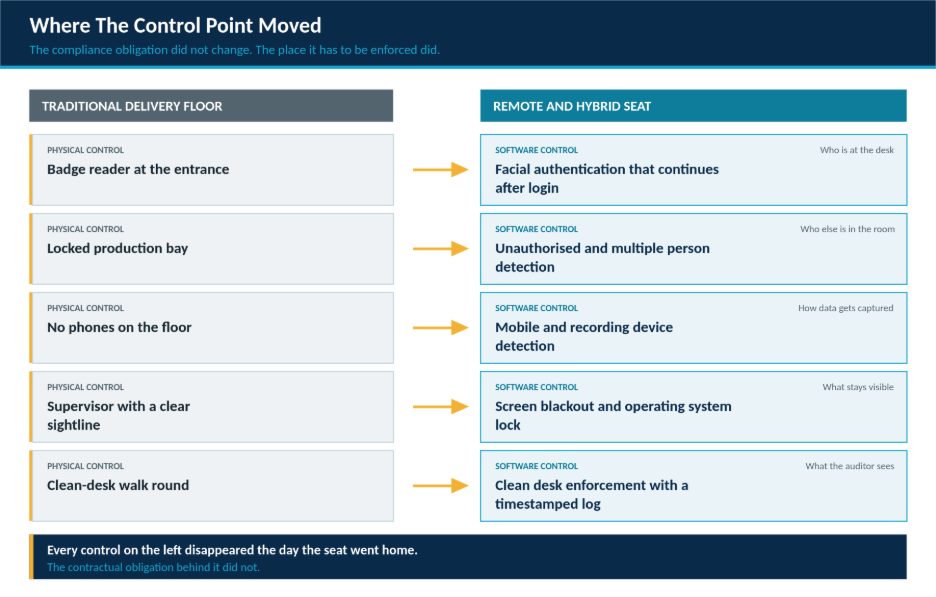
On a traditional delivery floor, a large share of the control framework was physical and implicit. Badge readers, locked production bays, prohibited phones, clean-desk checks and a supervisor with sightlines did much of the work, and the written policy simply recorded what the building already enforced. Move the same agent into a home and every one of those controls disappears at once, while the contractual obligation stays exactly where it was.

Your Obligations Did Not Move. Your Control Point Did.
wAnywhere enforces identity, screen and workspace controls at every agent seat and leaves an audit ready record behind, across remote, hybrid and onsite delivery.
Why Client Data Is Harder To Protect In Remote And Hybrid Seats
Client data is harder to protect in remote and hybrid seats because the controls that fail are physical rather than technical, and physical failures leave no trace in the systems auditors usually read. A screen photographed over an agent shoulder produces no download, no file transfer and no anomalous login.
The Security Perimeter Moved Into Homes
The delivery floor used to define the boundary. For a large share of outsourced headcount it no longer does. Seats now sit in bedrooms, shared flats, coworking desks and family living rooms, each with its own visitors, its own devices and its own line of sight to the monitor. The provider carries the same contractual liability for every one of those rooms and has visibility into none of them by default.
Screen Exposure Leaves No System Log
Visual exposure is the quietest failure mode in outsourcing. Customer records, payment details, health information and client systems are on screen continuously during normal work, which means exposure needs no breach and no malware. It needs one other person in the room. Traditional tooling is built to watch data in motion, so this risk passes through it untouched unless something is watching the workspace itself.
One Floor Now Serves Many Clients At Once
Providers rarely run a single contract per site. An agent may move between a healthcare programme in the morning and a card payments programme in the afternoon, each carrying different restrictions on what may be seen, stored or spoken aloud. In a remote setup those boundaries have to be enforced by software and timestamped per session, because there is no team leader in the aisle to notice when a rule is bent.
What Standards BPO Software Companies Have To Satisfy
Most outsourcing contracts inherit their security requirements from the client regulatory environment rather than inventing new ones. The table below maps the frameworks that appear most often in client questionnaires to what each one actually demands at the agent seat, which is the part generic compliance summaries tend to skip.
| Framework | What It Demands At The Seat |
| PCI DSS | Restrict cardholder data to staff with a business need, prevent copying or recording of card details, and keep an auditable record of access to the environment. |
| HIPAA | Apply physical and technical safeguards to protected health information, including workstation use rules and controls on who can view a screen. |
| GDPR | Limit processing to defined purposes, apply appropriate technical and organisational measures, and demonstrate accountability with records rather than assertions. |
| SOC 2 | Show that stated controls operated effectively throughout the review period, not simply that they were designed and documented. |
| ISO 27001 | Operate a risk based management system covering physical and environmental security, access control and evidence of continual review. |
| DPDP Act | Process personal data for a lawful purpose with reasonable security safeguards, and maintain a position you can defend to the regulator. |
Two themes run through all six. Each framework asks the provider to limit who can see data, and each asks for proof that the limit held. Seat level controls answer the first. Evidence capture answers the second, and it is usually the one that is missing when a client audit goes badly.
Also Read : 7 Most Pressing Challenges And Solutions For BPOs In Remote Work
7 Controls That Protect Client Data At The Agent Seat
These seven controls carry most of the compliance load in a remote or hybrid delivery model. None of them replaces network security, endpoint protection or access management. They sit underneath those layers and cover the physical ground that none of them can reach.
1. Identity Verification That Continues After Login
A login proves a credential was presented. It does not prove who is at the keyboard an hour later. Continuous identity verification through AI powered facial authentication checks presence across the session instead of only at the start, which closes the handover and credential sharing scenarios that single sign on cannot see.
2. Unauthorised Presence Detection
The second person in the room is the risk that onsite supervision used to handle. Software equivalents flag when an unrecognised face appears in view and when more than one person is present at the workstation. Dedicated unknown person detection separates these two cases, because an unrecognised user and an extra viewer call for different responses.
3. Recording Device And Clean Desk Control
A phone is the simplest exfiltration tool in existence and leaves no digital trail at all. Mobile detection at the seat addresses the capture route directly, while clean-desk enforcement covers written notes, printed material and secondary screens. In card and health programmes these two controls usually carry more weight than any network rule.
4. Screen Exposure Controls
When presence rules are breached the response has to reach the screen itself. Screen blackout, operating system lock and masking of sensitive fields shrink the exposure window from minutes to seconds, and they work alongside data breach security controls rather than duplicating them.
5. Transfer And Copy Restriction
Copy and paste, removable storage, printing, screen capture and personal cloud uploads are the common routes by which client data leaves an approved environment. Restricting them per programme rather than per device matters in multi client operations, because the same agent may be permitted an action on one contract and prohibited from it on another.
6. Location And Network Assurance
Several client contracts and data residency rules specify where work may be performed. Location and network checks confirm that an agent is logging in from an approved place on an approved connection, which turns a clause in a master services agreement into something the provider can actually verify each shift.
7. Session Level Evidence Capture
Every control above has to leave a record. A timestamped event, the policy that was breached, the response that followed and the reviewer who closed it form the evidence chain that clients sample during audits. Without it the provider can describe its controls but cannot demonstrate them, which in most frameworks counts as the same thing as not having them.
Prove Your Controls Were Running, Not Just Documented
Detect seat level risks, respond automatically and hand your client a timestamped evidence trail for every programme you deliver.
How Compliance Software Turns Controls Into Audit Evidence
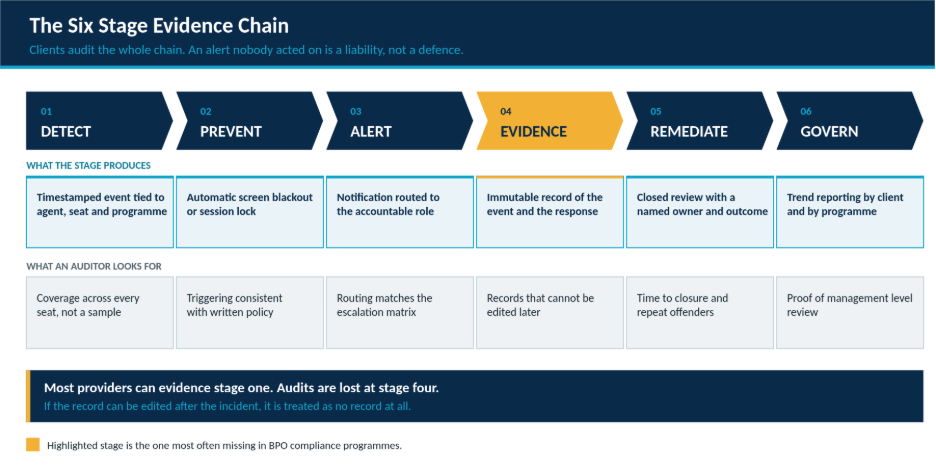
Detection has almost no compliance value by itself. An alert that nobody acted on is a liability in an audit rather than a defence, because it establishes that the provider knew and did nothing. What clients assess is the full chain from signal to governance, and each stage needs a different artefact.
| Stage | What It Produces | What An Auditor Looks For |
| Detect | A timestamped event tied to an agent, seat and programme | Coverage across all seats, not a sample |
| Prevent | An automated action such as blackout or session lock | Consistent triggering against written policy |
| Alert | Notification routed to the accountable role | Routing that matches the escalation matrix |
| Evidence | An immutable record of event and response | Records that cannot be edited after the fact |
| Remediate | A closed review with an outcome and owner | Time to closure and repeat offender handling |
| Govern | Trend reporting by programme and client | Evidence of review at management level |
A provider that can walk a client through all six stages for a single incident usually passes the audit. A provider that can show only the first stage usually does not, however good the underlying technology is.
How To Evaluate BPO Compliance Software
Evaluations tend to go wrong in the same way, by scoring feature lists instead of testing whether the platform survives contact with a real delivery model. Four questions separate the two.
Does It Cover The Physical Risks Or Only The Digital Ones
Ask the vendor to demonstrate a second person appearing behind a seat and a phone being raised toward a screen. Many platforms marketed for outsourced operations handle neither, because they were built for productivity reporting and extended into security later.
Can Policy Vary By Client Programme
A single global policy fails the moment one contract permits what another forbids. Configuration needs to follow the programme an agent is logged into, with the applicable rule recorded against each session.
Is The Evidence Exportable And Tamper Resistant
Evidence has to leave the platform in a form a client auditor accepts, and it has to be clear that records cannot be altered after an incident. A dashboard that only renders on screen will not survive a serious review.
What Happens When A Violation Occurs
Map the exact sequence of alert, automated action, review and closure before signing anything, and confirm who is accountable at each step. Common configuration questions of this kind are addressed in the wAnywhere product FAQ, and the answers are worth comparing against whatever a vendor commits to verbally.
Also Read: Strengthen Your BPO Security And Gain Control Over Emerging Threats
Privacy Guardrails That Keep Seat Level Monitoring Defensible
Monitoring at the seat is intrusive by design, which is precisely why it needs boundaries. Without them it drifts into general surveillance, damages retention in an industry that already struggles with it, and creates fresh regulatory exposure of its own. Five guardrails keep the balance right.
- Scope every control to a documented security purpose such as client data protection, never to general behaviour tracking.
- Apply role-based access so only named reviewers can open event records or images.
- Set retention limits that match the investigation window rather than keeping everything indefinitely.
- Tell agents plainly what is monitored, when it applies and what happens after a trigger, before go live rather than after.
- Review the configuration with legal and privacy teams in every jurisdiction you deliver from, because requirements vary widely and one setup rarely fits all sites.
Governance, rather than the technology itself, decides whether a deployment reads as a targeted security control or as surveillance. Clients increasingly ask about this directly, so a clear position is a commercial asset and not only a legal one.
How wAnywhere Supports BPO Compliance
wAnywhere brings seat level compliance controls into one platform instead of leaving them scattered across separate tools. It combines facial authentication, unrecognised person detection, multiple person detection, not at desk detection, mobile detection, screen controls, transfer restriction, compliance reporting and automated remediation.
Each detection feeds the same reporting and remediation workflow, so an event raised at a home seat in one country and an event raised on a production floor in another arrive in the same queue, with the same record structure and the same escalation path. For providers running several client programmes across mixed delivery models, that consistency is what makes an audit answerable rather than an exercise in reassembling logs.
Conclusion
Outsourced delivery did not get less regulated when seats went home. It got harder to prove. The obligations in a master services agreement stayed exactly where they were while the controls that quietly satisfied them, the badge reader and the locked bay and the supervisor with a clear line of sight, stopped existing.
Compliance software for BPO and call center operations rebuilds those controls in a form that travels with the agent, and then does the part the physical floor never had to do, which is leave behind an evidence trail. The providers that win security led contracts over the next few years will not be the ones with the longest policy documents. They will be the ones that can show, for any seat on any day, who was there, what was visible and what happened next.
Frequently asked questions
How Do BPO Software Companies Protect Client Data In Remote Seats
By moving the control point from the building to the seat. Facial authentication confirms who is present, detection flags extra people and phones, transfer rules block copying, and every trigger is logged with its response.
Is Call Center Compliance Software Different From Employee Monitoring
Yes. Monitoring measures productivity. Compliance software enforces defined obligations such as PCI DSS or HIPAA, applies narrower controls, and is judged on audit evidence rather than activity reporting.
Which Compliance Standards Apply To BPO Operations
It depends on the client. PCI DSS covers card data, HIPAA health information, and GDPR or the DPDP Act personal data. SOC 2 and ISO 27001 are commonly required as independent assurance.
Can Compliance Software Prevent Data Breaches Completely
No. It reduces seat level risks such as visual exposure, unauthorised presence, recording devices and unapproved transfers. It supplements access management, endpoint security and data loss prevention rather than replacing them.
What Evidence Do Clients Ask BPOs To Produce
Timestamped violation records, the response to each, time to closure, coverage across all seats rather than a sample, and management level trend reporting. Records that can be edited afterwards count as none.
Does Seat Level Monitoring Create Privacy Risk
It can without boundaries. Scope controls to a documented security purpose, restrict who can view records, limit retention, tell agents before go live, and check local law in every delivery location.
How Should A BPO Start A Compliance Software Rollout
Start with the highest exposure programmes, usually payments and healthcare. Define policy per programme, agree the response path, communicate it to agents, then expand once the evidence chain is proven.

Table of Contents
Boost productivity and compliance with wAnywhere
Read summarized version with