

 Set as a preferred Google source
Insider threats have evolved from malicious intent to identity failures. In 2025, 88% of web app attacks involved stolen credentials, with enterprises losing $4.4M per breach. CEOs and COOs must shift from device-centric security to continuous identity verification and must also know how to detect a data breach when prevention alone isn’t enough.
Credential misuse drives insider incidents. Proxy logins, shared accounts, and session hijacking bypass traditional perimeter defenses. Remote BPO workforces amplify this risk. For executives, this makes identity the top security concern demanding immediate attention.
Device trust fails when identities roam freely. Laptops can be wiped clean, but accounts live on, moving between sessions, locations, and even users. Tracking this requires continuous user activity monitoring — not just perimeter controls. The executive pivot: make identity your new security perimeter.
What is an AI Facial Recognition System?
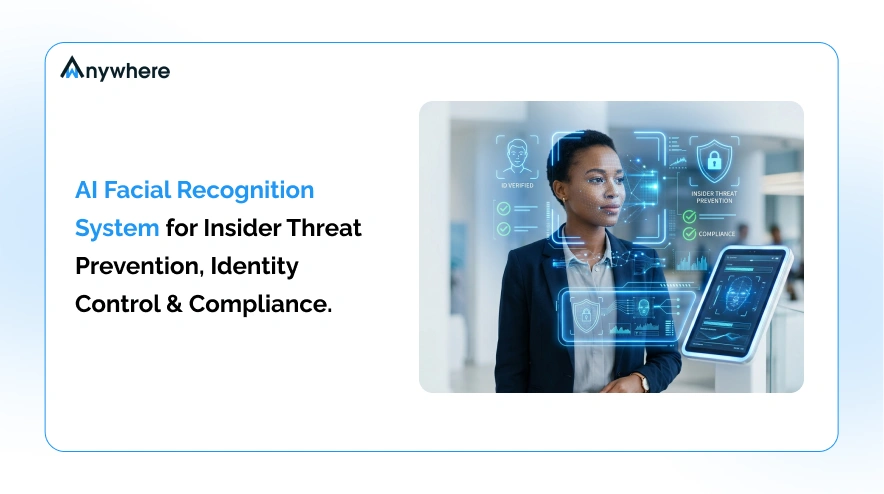
AI facial recognition systems use machine learning to identify and verify individuals by analyzing unique facial features from live video or photos. Enterprise versions continuously authenticate users during work sessions, preventing unauthorized access through real-time biometric matching against enrolled employee profiles.
Detection vs Recognition vs Verification
| Type | What it does | Security use cases | Enterprise example |
| Detection | Finds if a face exists in frame | Basic surveillance, headcount | “Someone’s at the workstation” |
| Recognition | Matches face to known database | Visitor identification, attendance | “This matches Employee #247” |
| Verification | Confirms this specific person | Access control | “User matches account holder John Doe” |
Role in Workforce Security
Links every login, data access, and sensitive action to a verified human identity. Prevents proxy logins, shared credentials, and session hijacking by requiring continuous biometric proof throughout the workday. Creates immutable audit trails proving “John Doe accessed customer PII at 2:37 PM from Mumbai.”
How AI Facial Recognition Works (Step-by-Step)
Enterprise facial recognition follows a precise technical workflow ensuring security without user friction.
- Face Enrollment: During onboarding, employee webcam registers face via mobile app or desktop. Creates an encrypted facial ID template stored locally; no raw photos are transmitted.
- Real-Time Capture: Every login trigger webcam scan. AI analyzes face for registered user matches while checking for multiple persons or not-at-desk scenarios.
- Liveness Detection: Built-in anti-spoofing verifies live humans (not photo/mask). Ensures only real employees authenticate, blocking unauthorized access attempts.
- Template Matching: Facial ID compared to enrollment template. Instant match grants access; unknown face triggers immediate system block.
- Continuous Monitoring: Runs silently during work session. Detects unknown persons, multiple logins, or mobile usage violations with real-time manager alerts.
- Audit & Actions: Immutable logs stored in the wAnywhere audit trail, record every verification (user + timestamp + device).. Configurable responses: screen blackout, OS lock, or OTP fallback.
Why Traditional Monitoring Fails to Prevent Insider Threats
Traditional tools watch what happens, not who makes it happen. They create a dangerous illusion of control while the real threat hides behind legitimate credentials. Here is why traditional monitoring fails to prevent insider threats:
Tracks activity, not identity
DLP flags data exfiltration, SIEM logs suspicious behavior, but neither verifies who triggered the alert. “John’s account downloading customer PII” looks legitimate even if it’s his temp covering the graveyard shift. Executives see alerts, not accountability.
Cannot detect proxy access
Shared credentials let contractors, temps, or attackers work undetected. 83% of organizations faced insider attacks using legitimate accounts last year. Traditional monitoring logs clean activity while fraudsters operate freely.
No continuous verification
One-time MFA or Multi-Factor Authentication at login leaves 8-hour sessions exposed. Someone steals coffee credentials at 9 AM, works undetected till 5 PM. BPO leaders lose accountability when “John’s login” accesses sensitive data from unknown faces.
Benefits of AI Facial Recognition in Enterprises
Enterprise deployments deliver immediate ROI across security, compliance, and operations.
Zero proxy attendance
Eliminates buddy punching across shifts. Night agents can’t proxy for day staff. Direct payroll savings through verified attendance only.
Compliance automation
GDPR/HIPAA audit trails are generated automatically. Proves compliant customer data access for offshore contracts. Single sources eliminate accountability disputes.
Real-time threat blocking
Unauthorized faces locked out instantly before data access. No human review delays. Stops breaches at authentication layer.
Global scalability
Works across 50+ countries, all lighting conditions. Standardized verification for multinational BPO delivery centers.
No hardware required
Uses existing webcams/VDI sessions. Zero CapEx deployment across the global workforce. Immediate rollout capability.
Employee acceptance
Privacy-first design achieves high adoption. Transparent consent builds trust. Minimal workflow disruption.
BPO-specific wins
Proves compliant offshore data access. Eliminates “he said/she said” disputes. Single verification source for client audits.
How AI Facial Recognition Prevents Insider Threats
AI facial recognition stops insider threats by continuously proving the human behind every action. Unlike passwords or MFA, it operates invisibly, verifying identity throughout the entire work session. Four key mechanisms create unbreakable human accountability across distributed BPO workforces.
Real-Time Identity Verification
Every click, download, or login triggers facial scan matching live video to enrolled profiles within 300ms. Blocks proxy attendance instantly, no face, no access. Ensures only authorized employees reach customer data or sensitive systems.
Multiple-Person Detection
Multiple person detection alerts when 2+ faces appear during authentication. Catches shoulder-surfing, shared workstations, or fraud rings operating together. BPO bonus: Prevents “ghost employees” from remotely clocking in for absent colleagues.
Unauthorized Access Prevention
Immediate session lockout if the face doesn’t match the account holder. Works across VDI, VPN, laptops, and even smartphone apps. Zero-notice blocking stops data breaches before exposure, maintaining compliance even during active fraud attempts.
Continuous Authentication
Passive re-verification every 5-15 minutes or privilege escalation. No user friction as it runs silently via webcam. Stolen credentials become useless mid-session when the wrong face appears behind the legitimate login.
Limitations & Challenges
No technology eliminates all risks. Executives must understand real-world constraints before enterprise deployment.
Lighting/angle limitations
Poor webcam quality, backlighting, or extreme head angles reduce accuracy. Enterprise systems handle most conditions but struggle with industrial lighting or outdoor glare. Solution: Minimum webcam requirement plus user positioning guides.
Employee resistance
Initial privacy concerns create adoption friction. Employees fear constant monitoring despite security benefits. Addressed through transparent enrollment videos, opt-out alternatives, and personal data dashboards showing exactly what gets tracked.
False positives
Legitimate users occasionally rejected due to new hairstyles, glasses, or aging. Multi-factor fallbacks like OTP prevent lockouts while maintaining security. Configurable thresholds balance usability versus protection based on data sensitivity.
Regulatory complexity
EU AI Act classifies facial recognition as high-risk, requiring documented risk assessments and human oversight protocols. Compliance-ready vendors provide pre-audited frameworks. Requirements vary by jurisdiction.
Integration overhead
Legacy Active Directory sync challenges arise with older systems. Modern standards solve most cases. VPN or VDI environments need webcam forwarding configuration. Deployment typically takes a few weeks for global enterprises.
Strategic mitigation
Deploy with human oversight and fallback authentication during pilot phase. Privacy-first vendors reduce adoption barriers through consent transparency. Start with high-risk teams before full rollout.
Role in Zero Trust Security
Zero Trust’s “never trust, always verify” principle demands continuous human proof beyond MFA and device checks. Facial recognition becomes the critical identity layer, verifying who sits behind authorized accounts.
Enterprise integration stack:
MFA confirms password ownership
Device posture validates endpoint security
Facial verification proves human identity
Contextual risk adds behavioral analytics
BPO impact: Remote agents accessing customer data must pass biometric gates every session. This complements Endpoint Detection and Response by securing the human variable that traditional Zero Trust frameworks miss. Facial recognition turns identity into the unbreakable final security layer.
Compliance & Regulatory Alignment
Facial recognition generates immutable audit trails. Every access tie to verified identity + timestamp + context (location, device). Facial recognition turns compliance from a burden to a competitive advantage.
| Standard | Requirement | BPO Compliance Win |
| GDPR | Identity accountability | Biometric logs prove agent accessed customer PII |
| HIPAA | Audit controls | Verifies call center staff viewing patient records |
| SOC 2 | Access control testing | Real-time identity + failed proxy attempt logs |
| ISO 27001 | A.9.4 Logging | Tamper-proof facial verification for offshore teams |
Industry Use Cases
Facial recognition solves identity gaps across high-stakes industries where proxy access creates existential risks. BPO executives see direct parallels. Customer data demands the same verification rigor as patient records or trading platforms. Real-world deployments prove immediate ROI through prevented fraud and compliance.
BPO
Call centers eliminate buddy punching and remote proxy attendance fraud. Verifies agents before customer data access. Provides compliance proof for offshore operations while securing client PII across global delivery centers.
Read More – Strengthen Your BPO Security – Gain control over emerging threats
BFSI
Algorithmic trading firms use facial gates for high-frequency trading platform access. Only verified traders execute multimillion-dollar orders. Prevents rogue contractors or session hijackers from triggering market-moving trades during critical windows.
Healthcare
Hospitals verify surgeons and clinical staff before accessing electronic patient records. Ensures only authorized physicians view sensitive health data. Meets HIPAA audit requirements while eliminating proxy access risks in emergency departments and remote telemedicine sessions.
SaaS
Remote-first companies protect admin consoles and privileged accounts. Blocks account takeover attempts at login. Ensures only legitimate administrators manage customer tenants, preventing widespread service disruptions from compromised superuser credentials.
Privacy, Ethics & Responsible AI
Executives demand privacy-first biometrics that build trust, not compliance with headaches. Responsible facial recognition balances security with employee rights through deliberate design choices that regulators reward, and boards approve.
Consent & transparency
Employees receive clear enrollment videos explaining data use and retention. Opt-in required with equivalent verification alternatives. Transparency dashboards show personal verification history. Builds trust while meeting “informed consent” mandates.
Data protection
On-device biometric processing eliminates cloud transmission risks. Raw images convert to encrypted mathematical templates. No identifiable facial data is stored. 30-day audit retention, then automatic deletion. Meets the GDPR data minimization principle.
Ethical implementation
Regular bias testing across global demographics ensures lower false rejection rates. Third-party audits are published quarterly. Employees control data access and deletion rights. Transparency prevents “black box” perception while maintaining enterprise-grade security.
Privacy-first design turns regulators from adversaries to allies. Published audit reports and consent frameworks satisfy board oversight. Employees embrace verification, knowing their data rights exceed legal minimums.
Future of Identity Control
Identity control evolves from periodic checks to continuous, invisible human verification. Tomorrow’s security eliminates passwords entirely, replacing them with seamless biometric and behavioral proof. BPO leaders adopting it now are gaining first-mover advantage in compliance and fraud prevention.
Continuous Biometric Authentication
Verifies identity in every interaction without user friction. Webcams passively confirm the human behind sessions, eliminating re-login prompts. Works across VDI, mobile apps, and physical access points simultaneously.
Passwordless Workplaces
Eliminates username/password vulnerabilities entirely. Employees authenticate via face scan at session start, then continuously throughout the workday. Combines biometrics with device trust for frictionless, phishing-proof access to all corporate systems.
AI Risk Scoring
Combines facial verification with keystroke patterns, mouse movements, and location data. Dynamic threat scores adjust access in real-time. High-risk sessions trigger additional verification before sensitive data access, preventing fraud before it occurs.
Read More: Role of Facial Recognition Attendance Systems in Modern Workplaces
How to Choose the Facial Recognition Right Solution
BPO executives need enterprise-grade facial recognition that scales globally without creating new risks. The wrong vendor creates compliance headaches and employee resistance. Demand these non-negotiable capabilities for Zero Trust success.
Real-time detection
- Sub-500ms verification prevents workflow disruption
- Multi-face alerts catch fraud rings instantly
- Liveness detection blocks photos/masks/deepfakes
- Works across lighting conditions and camera angles
Compliance-ready
- GDPR/HIPAA/SOC 2 audit trail generation
- Immutable logs with identity + timestamp + context
- Active Directory/SCIM integration
- Third-party compliance certification
Privacy-first
- On-device biometric processing (no cloud transmission)
- Encrypted templates, not raw images
- Employee data control and deletion rights
- Transparent consent workflows
Accuracy & alerts
- 99.5%+ accuracy across global demographics
- False acceptance <0.1% for high-stakes environments
- Customizable alert thresholds and escalation
- Real-time dashboard with risk trend analysis
How Enterprises Use wAnywhere for Security & Compliance
Global enterprises deploy wAnywhere facial recognition across distributed BPO workforces. The platform combines AI identity verification with compliance-grade monitoring without hardware investments.
AI-powered identity verification
Facial authentication integrates with Active Directory and MFA. Registers employee faces during onboarding for daily logins. Unknown person detection blocks unauthorized access instantly across Windows, macOS, Linux, and Chromebook.
Security + compliance-first
Real-time detections for multiple persons, not-at-desk, and mobile usage. Generate audit trails proving compliant access to customer data. PII masking and DLP features protect sensitive information during operations.
Real-time alerts & monitoring
Dashboard visualizes violations with instant notifications. Configurable actions include screen blackout, OS lock, or OTP challenges. API integration feeds data into existing incident management workflows for centralized response.
Conclusion
Identity has become the new security perimeter. Traditional perimeter defenses fail when legitimate credentials move to unauthorized humans across remote BPO workforces. Executives must now secure the human variable, not just endpoints and networks.
Facial recognition delivers proactive defense through continuous verification. It eliminates proxy access, session hijacking, and ghost employees before breaches occur. Unlike reactive monitoring tools, this invisible human accountability transforms security from a cost center to a compliance advantage.
Platforms like wAnywhere prove enterprise-scale deployment works. Modern BPO leaders adopting continuous identity verification now meet regulatory demands while gaining customer trust. Forward-thinking COOs turn compliance into strategic differentiation across global delivery markets. Start your free trial.
FAQs
How accurate is AI facial recognition?
Enterprise systems achieve 99.7% accuracy across lighting conditions. False acceptance <0.1%, critical for high-stakes access control.
Does it help with compliance?
Absolutely. Generates GDPR/HIPAA/SOC 2 audit trails linking every action to verified identity. Immutable logs prove accountability to regulators.
What about privacy concerns?
Privacy-first systems use on-device processing with encrypted templates, not raw images. Employees control data + receive clear consent documentation.
Can it detect spoofing attempts?
Advanced liveness detection identifies photos, masks, and deepfakes using 3D depth + micro-movement analysis. 99.9% anti-spoofing effectiveness.

Table of Contents
Boost productivity and compliance with wAnywhere
Read summarized version with