

 Set as a preferred Google source
In today’s digital workplace, employees connect USB drives, external hard disks, Bluetooth headsets, and other removable peripherals to their workstations multiple times a day. This kind of convenience keeps work moving.
But it also opens a door that many organizations never think to lock. A single unchecked connection can turn a routine task into a serious security incident. Most IT teams only realize the gap exists after something has already gone wrong.
The hidden risk behind everyday USB and Bluetooth use
Every plugged in drive or paired device carries a trade off between convenience and risk. Most employees never stop to think about which side of that trade off they are on.
An employee copying a presentation onto a personal USB drive before a client meeting is one example. A technician pairing an unauthorized Bluetooth speaker to a work laptop is another. So is a new hire plugging in a drive they found in a desk without knowing where it came from. These are everyday moments that carry outsized risk.
None of these actions look suspicious in the moment. That is exactly what makes them dangerous. An infected USB drive can introduce malware within seconds of being connected. A file copied onto an unmonitored device can leave the organization without ever triggering a single alert.
Why USB and Bluetooth devices are a growing security blind spot
Removable storage and wireless peripherals sit in a strange middle ground of enterprise security. They are common enough to be ignored, yet powerful enough to bypass many of the controls organizations already have in place.
Left unmanaged, they create several distinct categories of risk:
- Data theft through removable storage devices
- Malware and ransomware infections introduced through infected drives
- Unauthorized transfer of confidential documents to personal devices
- Policy violations that lead to compliance failures
- Loss of intellectual property through undetected file transfers
- A general rise in cybersecurity threats as attack surfaces expand
According to Honeywell’s 2024 USB Threat Report, 51 percent of malware analyzed is now designed to spread via USB devices, nearly six times the 9 percent recorded in 2019.
The shift to hybrid and remote work has made this blind spot larger. Employees now work across home networks, coworking spaces, and personal devices, often outside the direct line of sight of IT and security teams.
Controlling what plugs into an endpoint, and what pairs with it wirelessly, has become just as important as controlling what runs on it.
Read More:How wAnywhere leverages AI to maintain security & compliance across your remote work environment

Stop unauthorized devices before they become a breach.
How wAnywhere detects and prevents unauthorized device use
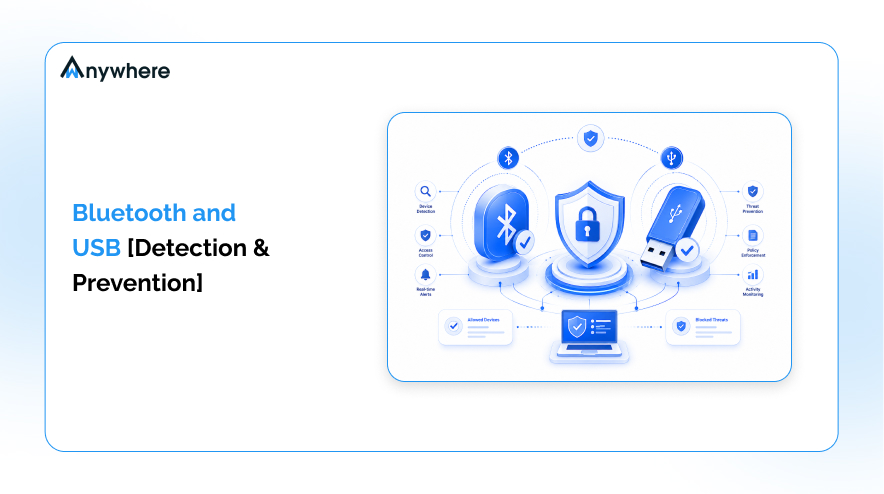
wAnywhere closes this gap by giving organizations continuous, real-time visibility into every USB and Bluetooth event happening across their endpoints. IT teams no longer need to manually check each device.
Real-time detection on connect and disconnect
The moment a USB drive is plugged in or a Bluetooth device is paired, wAnywhere detects the event instantly. The same holds true when a device is disconnected.
This real-time detection means security teams are never working from stale information. They know what is connected, when it connected, and to which endpoint, as it happens rather than after the fact.
Policy-based alerts versus auto-block
Not every organization wants to handle device control the same way. wAnywhere is built to support both approaches.
Security teams can configure the system to send instant alerts when an unrecognized device connects. This gives administrators the choice to investigate before taking action.
Alternatively, stricter environments can enable automatic blocking. Unauthorized devices are prevented from establishing a connection at all. This flexibility allows organizations to match their device control policy to their actual risk tolerance instead of forcing every team into the same rigid rulebook.
Simple three step flow: detect, alert or block, log
At its core, wAnywhere’s process is built around three straightforward steps.
First, the system detects any USB or Bluetooth activity the moment it occurs, whether that is a connection, a disconnection, or a pairing attempt.
Second, based on the policy configured by the organization, wAnywhere either sends an alert to the relevant administrator or blocks the device outright before any data can move.
Third, every single event, whether allowed, alerted on, or blocked, is logged in detail for later review. This log becomes the backbone of audits, investigations, and compliance reporting, so nothing that happens at the endpoint ever goes unrecorded.
See every USB and Bluetooth connection across your endpoints.
Key benefits of USB and Bluetooth device control
Bringing USB and Bluetooth activity under a single point of control changes the security posture of an organization in several concrete ways.
Prevent unauthorized data transfers
USB storage remains one of the simplest ways for confidential information to leave a company unnoticed. By detecting and restricting unauthorized USB devices, wAnywhere significantly reduces the risk of sensitive files, client data, or intellectual property being copied out without approval.
Protect endpoints from malware
External devices are a well known entry point for malware and ransomware. By monitoring and controlling what connects to company systems, organizations reduce the chances of a single infected drive compromising an entire network.
Strengthen compliance
Industries such as banking, insurance, healthcare, and government operate under strict data protection obligations. Detailed audit logs of every USB and Bluetooth event give compliance officers the documentation they need to demonstrate that removable device usage is being actively managed, not just assumed to be safe.
Improve security visibility and reduce insider threats
Not every risk comes from outside the organization. Insider threats, whether intentional or the result of carelessness, are just as capable of causing damage.
Fortinet’s 2025 Insider Risk Report found that 47 percent of security leaders are concerned about removable storage devices like USB drives as a channel for data leaving the organization.
With centralized visibility into device activity across every endpoint, security teams can spot unusual patterns, investigate suspicious behavior early, and act before a small incident becomes a major breach.
Also Read: Insider Risks vs Insider Threats – Understanding the Difference and Leveraging AI Security Solutions
Industries most at risk
Some sectors face sharper consequences than others when endpoint device control is missing.
- BFSI: Financial institutions handle highly sensitive customer and transaction data, making them a prime target for data theft through removable devices.
- Healthcare: Patient records and medical data are subject to strict privacy regulations, and a single unauthorized transfer can trigger serious compliance consequences.
- Legal: Law firms manage confidential case files and client communications that must never leave the organization through untracked channels.
- Government: Public sector systems often hold classified or citizen data, where even a minor breach can carry national level implications.
Key features to look for
Organizations evaluating device control solutions should look for the following capabilities:
- Real-time USB device detection
- Bluetooth device monitoring
- Unauthorized device prevention
- Instant security alerts
- Detailed audit logs
- Centralized endpoint visibility
- Configurable security policies
- Compliance reporting
- Integration with broader workforce monitoring and endpoint security tools
Best practices for removable device control
Technology alone is not enough. Organizations get the most out of device control when it is paired with clear policy and consistent practice.
An allow-list approach, where only approved USB devices and Bluetooth peripherals are permitted, works far better than trying to blacklist every possible risk after the fact. Everything outside that approved list should remain blocked by default rather than allowed until proven dangerous.
Regular audits of device activity logs help catch gradual policy drift before it becomes a real problem. Ongoing employee awareness programs ensure that staff understand why these controls exist rather than viewing them as an obstacle.
Continuous monitoring ties all of this together, turning device control from a one time setup into an ongoing security practice.
Conclusion
USB drives and Bluetooth devices may look harmless on the surface. Left unmanaged, they are capable of causing data loss, malware infections, and serious compliance violations.
wAnywhere’s Bluetooth and USB Detection & Prevention gives organizations real-time visibility into endpoint device activity, the ability to stop unauthorized connections before they become incidents, and the audit trail needed to prove compliance when it matters most.
For IT and security teams looking to close one of the most overlooked gaps in endpoint security, this is a practical, immediate place to start. Request a demo to see how wAnywhere can bring your organization’s USB and Bluetooth activity under control.
Real-time device control for teams that can’t afford a data leak.

Read summarized version with


Table of Contents