

 Set as a preferred Google source
TL;DR
Quick answer A data processing agreement is the contract that sets out how a BPO may handle a client’s personal data, including instructions, security measures, sub-processors, breach support and audit rights. Signing it is only half the job. BPOs must also enforce every clause on every seat and be able to prove it.
What this blog covers
- What a DPA is and when it is required
- The clauses GDPR makes mandatory for processors
- Extra clauses BPO clients commonly add
- Why enforcement matters more than the signature
- How to turn DPA clauses into day-to-day controls for office and remote agents
- A readiness checklist and common mistakes to avoid
Every BPO that handles customer data on behalf of a client works under a set of promises about that data. In most regulated relationships, those promises live in a data processing agreement, and clients are reading them far more closely than they used to.
The reason is simple. Verizon’s 2026 Data Breach Investigations Report found that 48% of breaches involved a third party, a 60% increase on the previous year’s dataset. Clients now know that their outsourcing partner is one of their largest risks, and the DPA is where they try to control it.
This guide explains what BPOs must sign, which clauses clients add, and how BPO monitoring helps turn contract language into controls you can prove. It is general information, not legal advice, so involve your legal team before signing any agreement.
What Is A Data Processing Agreement?
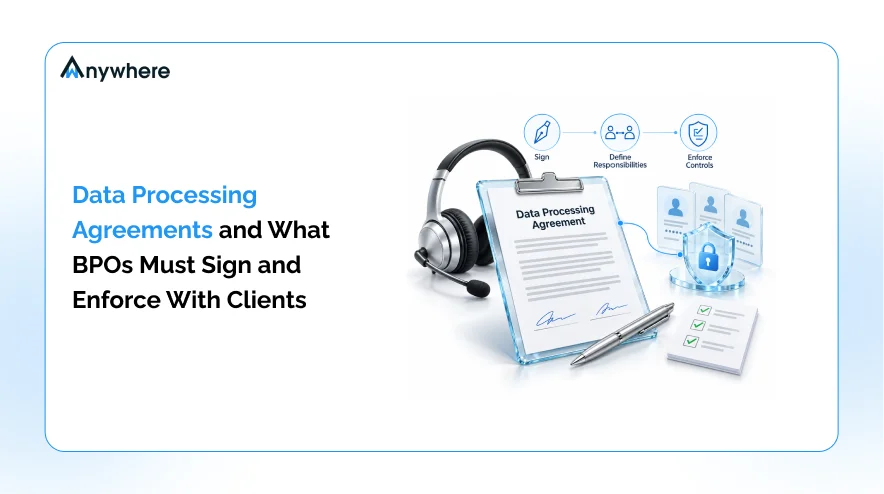
A data processing agreement is a legally binding contract between a data controller and a data processor that defines how the processor may handle personal data on the controller’s behalf. In outsourcing, the client is usually the controller and the BPO is the processor.
The agreement turns regulatory duties into specific contractual obligations. It states what data the BPO may process, for what purpose, under which security measures and for how long.
Controller, Processor And Sub-Processor Roles
Understanding the roles helps BPOs see where responsibility sits.
- Controller The client that decides why and how personal data is processed
- Processor The BPO that processes data on the client’s instructions
- Sub-processor Any vendor the BPO engages to help with that processing, such as a hosting or tooling provider
When A DPA Is Required
Under GDPR Article 28, processing by a processor must be governed by a contract or other legal act whenever personal data is processed on a controller’s behalf. Healthcare clients in the US use a Business Associate Agreement under HIPAA for the same purpose, and India’s Digital Personal Data Protection Act, 2023 also expects a valid contract when a data fiduciary engages a data processor.
What BPOs Must Sign Under GDPR
GDPR Article 28(3) lists terms every processing contract must include. Expect to see each of them in some form.
- Documented instructions Process personal data only on the client’s documented instructions.
- Confidentiality Ensure everyone authorized to process the data is bound by confidentiality.
- Security of processing Apply appropriate technical and organizational measures under Article 32.
- Sub-processors Engage sub-processors only with the client’s authorization and on equivalent terms.
- Data subject rights Help the client respond to requests from individuals.
- Compliance support Assist with security, breach notification and impact assessments.
- Deletion or return Delete or return all personal data when the services end.
- Audits Make available the information needed to demonstrate compliance and allow audits, including inspections.
Clauses BPO Clients Commonly Add
Most clients go beyond the legal minimum. These additions are where BPOs usually feel the operational pressure.
- Security schedules Specific controls such as clean desk rules, device restrictions and identity checks
- Breach notification timelines A fixed number of hours to report a suspected incident
- Monitoring and logging requirements Records of who accessed client data and when
- Data location rules Where data and monitoring records may be stored
- Remote work conditions Rules for agents working from home, including network and desk requirements
- Retention and deletion proof Evidence that data was removed at the end of the engagement
Negotiate Clauses You Can Actually Meet
Clients often send a standard template written for many vendors. Before signing, test each requirement against how your operation really runs. A four-hour breach notification window, for example, needs round-the-clock monitoring and a named escalation owner. If a clause cannot be met on day one, negotiate the wording or agree a timeline to close the gap, and record that agreement in writing.
Also Read :Why Workforce Compliance Fails In Large BPO Operations And How To Fix It
Why Signing Is Not Enough
A signed agreement protects no one if its clauses are not enforced on the floor and at home. Regulators and clients both look at what actually happened, not just what was promised.
Enforcement Is Active And Expensive
DLA Piper’s GDPR Fines and Data Breach Survey reported that European supervisory authorities issued fines totalling approximately EUR 1.2 billion in 2025. Information security was one of the areas where regulators remained most active.
Processors Carry Their Own Liability
GDPR does not shield processors. Under Article 82, a processor can be liable for damage where it has not complied with obligations directed at processors or has acted outside the controller’s lawful instructions. Under Article 28(10), a processor that decides its own purposes for processing is treated as a controller for that processing.
Clients Flow Their Own Obligations Down
Banks, insurers and healthcare providers face their own regulators. When they outsource, they pass those expectations to the BPO through the agreement and expect the same standard of evidence they would need to show internally.
Clients Audit The Reality
When a client exercises audit rights, it asks for evidence. A BPO that cannot show who accessed data, what controls were active and how incidents were handled is in breach of its contract, whatever its policies say.

Enforce Every DPA Clause On Every Seat
wAnywhere turns contract obligations into live controls and audit-ready records, for agents on the floor and at home.
How To Enforce DPA Obligations Across Office And Remote Agents
The most practical way to enforce an agreement is to map each clause to an operational control and to the evidence that proves it. BPO monitoring makes that mapping visible.
| DPA obligation | Operational control | Evidence for the client |
| Confidentiality of authorized staff | Verify the person at every screen | Identity logs tied to each session |
| Security of processing | Detect phones, extra people and unattended desks | Violation reports by agent and date |
| Process only on instructions | Restrict copy paste and USB transfers | Logs of blocked attempts |
| Breach support | Real-time alerts with tracked response | Incident timelines from alert to closure |
| Audit and inspection rights | Centralized activity records | Exportable reports for any period |
| Data location | On-premise or private cloud hosting | Deployment records |
Verify Who Touches Client Data
Facial recognition confirms the agent at the screen, which supports the confidentiality clause and stops shared logins from undermining it.
Close Everyday Data Exit Routes
Mobile detection, USB detection and copy paste restriction stop the most common ways personal data leaves a seat outside instructions.
Keep Evidence Ready For Audits
The wAnywhere audit trail and remediation workflow record each event and how it was resolved, giving clients the information Article 28 expects processors to make available.
Store Records Where Clients Require
Because wAnywhere supports on-premise or private cloud installation, BPOs can meet data location clauses for monitoring records as well as client data.
Make Your Next Client Audit The Easy Part
Verified identity, desk-level detection and complete activity records for every seat. See how wAnywhere supports your client commitments.
PII Compliance For Remote And Hybrid Agents
PII compliance becomes harder the moment agents leave the floor. Home desks introduce family members, personal devices and unknown networks into an environment the DPA assumes is controlled.
The Remote Risks Clients Worry About
- Other people viewing customer data on a home screen
- Phones used to photograph screens
- Data copied into personal files or apps
- Logins from unapproved networks or locations
Controls That Keep Remote Seats In Line
wAnywhere applies the same controls to home and office seats. Multiple person detection flags extra people near the screen, PII masking hides sensitive fields, SSID monitoring identifies unknown networks and geofencing confirms where agents work. Together they give clients confidence that personal data protection does not stop at the office door.
Respect Agent Privacy While You Monitor
Monitoring works best when agents understand it. Tell agents what is monitored and why, limit monitoring to working hours and work devices, and use masking so reviewers do not see more customer data than they need. Clear communication protects the BPO’s relationship with its people as well as with its clients.
Also Read: Is Your Remote Work Secure Enough A Security Checklist For BPO Operations
A DPA Readiness Checklist For BPOs
Use this checklist before signing a new agreement or renewing an existing one.
- Confirm whether you act as processor, sub-processor or controller for each data set.
- Check that every Article 28(3) term appears in the agreement.
- List every security schedule requirement and the control that meets it.
- Agree a breach notification timeline you can actually meet.
- Keep an up-to-date list of sub-processors and the client approvals for each.
- Confirm how long activity records are kept and where they are stored.
- Prepare a standard evidence pack for client audits.
- Document how data will be deleted or returned when the contract ends.
Common DPA Mistakes BPOs Make
Even experienced operations teams fall into these traps.
- Signing the client’s template unchanged Clauses that cannot be met operationally create breaches from day one.
- Treating remote seats as an exception Most agreements make no distinction between office and home.
- Adding tools without approval A new vendor that touches personal data may be an unapproved sub-processor.
- Relying on policy documents Clients want logs and reports, not handbooks.
- Losing track of deletion Data kept after the contract ends can breach the agreement and the law.
- No owner for the agreement When nobody in operations owns the contract, its obligations fade from daily practice within months.
Also Read: BPO Compliance Gaps And Why Problems Are Detected Too Late
Conclusion
A processing contract defines what a BPO has promised, but enforcement defines whether those promises hold. The BPOs that keep regulated clients map every clause to a control, apply those controls to every seat, and keep the evidence ready before anyone asks. Review each agreement at least once a year, and again whenever you add a new site, tool or remote team, because each change can affect what you have promised. If you are preparing for a new client agreement or an upcoming audit, a short wAnywhere demo will show you how each clause can be enforced and evidenced in practice.
Frequently asked questions
Is A DPA Mandatory Under GDPR?
Yes, GDPR Article 28 requires processing by a processor to be governed by a contract or other legal act that includes specific mandatory terms. Without one, both the client and the BPO are exposed.
What Is The Difference Between A DPA And A BAA?
A DPA governs personal data processing under GDPR, while a Business Associate Agreement governs protected health information under HIPAA. Healthcare BPOs serving US and European clients often need both.
How Can A BPO Prove It Complies With Its Processing Contract?
A BPO proves compliance by keeping verified activity records, violation reports and incident timelines that map to each clause. Clients review this evidence during audits and renewals.
How Does BPO Monitoring Support PII Compliance?
It supports it by detecting risky behavior, such as phones at the desk or copy paste attempts, and by masking sensitive data on screen. It also records each event for audits.

Table of Contents
Boost productivity and compliance with wAnywhere
Read summarized version with