

 Set as a preferred Google source
TL;DR
Quick answer Hybrid is now the most common arrangement for remote-capable employees, at 52% according to Gallup’s May 2026 data. Rigorous research, including a randomized trial published in Nature and industry analysis from the US Bureau of Labor Statistics, finds that remote and hybrid work does not reduce productivity on its own. The bigger risks for managers are trust gaps, uneven measurement and data security on remote seats.
What this blog covers
- The headline numbers at a glance
- How many people work remotely and in hybrid setups in 2026
- What research says about productivity
- Trust and engagement data managers should watch
- What the numbers mean for day-to-day management
- How to measure remote and hybrid productivity fairly
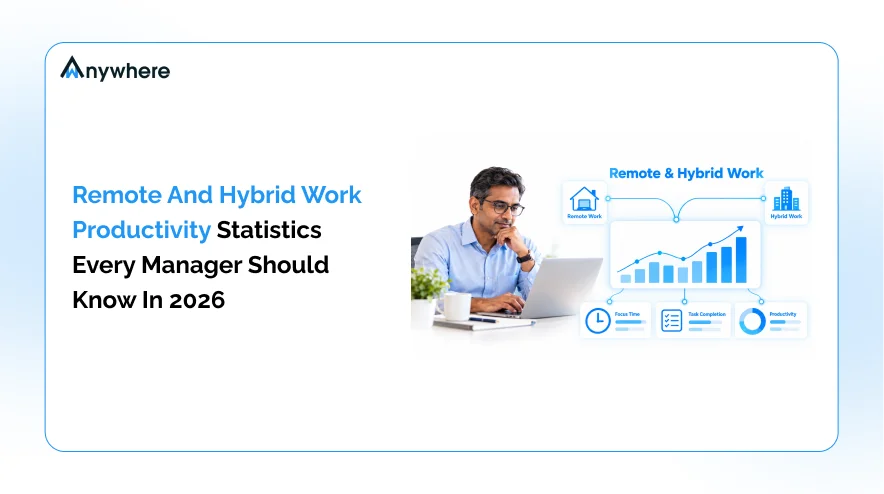
Remote and hybrid work does not reduce productivity on its own. That is the consistent finding across Gallup’s 2026 workforce data, a randomized control trial published in Nature and productivity analysis from the US Bureau of Labor Statistics. What the same research exposes is a measurement problem rather than a location problem, because close to half of managers still say they do not fully trust their teams to be productive while working remotely. The remote work productivity statistics below set out what those primary sources actually report, and how hybrid analytics and consistent employee productivity tracking across hybrid teams turn industry averages into numbers for your own workforce.
This roundup uses primary sources only, including Gallup, a peer-reviewed study in Nature and the US Bureau of Labor Statistics. It covers the hybrid work productivity statistics and work from home productivity statistics that matter most to operations heads, with guidance on what to do with them once the reporting is in front of you.
Remote Work Productivity Statistics At A Glance
Before the detail, here are the numbers worth remembering. Each comes from the organization that produced the research.
How Many People Work Remote And Hybrid In 2026?
The first question for any manager is how common each arrangement really is. The data shows that hybrid has settled in rather than faded.
Hybrid Is The Norm For Remote-Capable Roles
Gallup’s data from May 2026 shows that 52% of employees with remote-capable jobs work hybrid, 26% work exclusively remote and 22% work on-site. The hybrid share has stayed relatively steady since 2022, despite high-profile return-to-office announcements.
Most Employees Still Want Flexibility
When Gallup asked remote-capable employees about their preferred arrangement in November 2025, 61% chose hybrid, 33% chose exclusively remote and only 6% chose fully on-site. That gap between preference and on-site mandates is a retention risk managers cannot ignore.
Hybrid Employees Spend About Two Days A Week In The Office
Gallup found that hybrid workers spent 46% of their workweek on-site in 2025, the equivalent of about 2.3 days. For planning purposes, most hybrid teams are split close to evenly between office and home.
What This Means For Workforce Planning
With roughly half of remote-capable staff on hybrid schedules and about a quarter fully remote, most managers now lead teams that are never all in one place. Planning, coaching and performance reviews need to work just as well for the person at home as for the person at the next desk.

Replace Productivity Guesswork With Real Data
See active time, idle time and app usage for office and remote teams on one dashboard, alongside the security controls your clients expect.
Does Remote Work Hurt Productivity? What The Research Says
This is the question behind most return-to-office decisions. The strongest available evidence does not support the idea that remote or hybrid work damages output by default.
A Randomized Trial Found No Drop In Performance
In a six-month randomized control trial of 1,612 employees at a technology company, published in Nature in 2024, Nicholas Bloom, Ruobing Han and James Liang found that working from home two days a week reduced quit rates by one-third. Performance grades over the following two years showed no difference between hybrid and office-based employees.
Industry Data Points The Same Way
The US Bureau of Labor Statistics examined 61 private-sector industries and found that total factor productivity growth was positively associated with the rise in remote work, even after accounting for pre-pandemic productivity trends. Industries with larger increases in remote work also saw slower growth in unit costs.
What The Work From Home Productivity Statistics Do Not Tell You
Averages hide variation. A result across an industry or a single company does not guarantee the same outcome for every team, role or individual. Roles that depend on constant real-time collaboration may behave differently from focused individual work, and self-reported productivity is weaker evidence than measured output. The practical lesson is to measure your own teams rather than borrow a conclusion.
Common Myths The Data Does Not Support
Many policies are still built on assumptions the evidence has already tested. Reading remote work productivity statistics side by side exposes four of the most common.
Myth One, People Work Less At Home
The Nature trial found no difference in performance grades between hybrid and office-based employees over two years, and the BLS found productivity growth was higher in industries where remote work grew most. Neither supports the idea that home working is inherently slower.
Myth Two, Hybrid Work Weakens Engagement
Gallup’s 2026 data shows the opposite pattern for remote-capable roles, with exclusively remote and hybrid employees more likely to be engaged than their on-site peers.
Myth Three, Office Mandates Fix Productivity
No figure in this roundup shows that more office days lift output. What the data does show is a strong preference for flexibility, which makes strict mandates a retention risk.
Myth Four, Measurement Means Micromanagement
Measurement becomes micromanagement only when it is hidden or used to punish. Shared, transparent data is what closes the trust gap described below.
Hybrid Work Productivity Statistics On Trust And Engagement
Productivity depends on how people are managed as much as where they sit. Gallup’s trust and engagement data shows where hybrid management often breaks down.
The Trust Gap Is Real
In 2025, 54% of managers who supervise remote workers strongly agreed that they trust their teams to be productive while working remotely, and 57% of employees said they feel trusted by their manager to be productive remotely. Close to half of both groups fall short of full confidence, which is a management problem rather than a location problem.
Remote And Hybrid Employees Are More Likely To Be Engaged
Gallup’s May 2026 data shows that exclusively remote and hybrid employees are more likely to be engaged and thriving than on-site employees in remote-capable roles. Flexibility, used well, supports the conditions that drive performance.
What These Numbers Mean For Managers
Statistics only help if they change what managers do. Four practical lessons stand out.
Measure Work, Not Presence
If hybrid work does not reduce performance on its own, attendance alone is a poor measure of productivity. Focus on output, active time and how time is spent across applications and tasks, all of which consistent time tracking records the same way for office and remote staff.
Set Clear Hybrid Norms
Agree which days teams meet in person, what response times are expected at home, and which tasks suit each location. Clear norms remove much of the friction that gets blamed on location.
Close The Trust Gap With Shared Data
When managers and employees see the same objective data, conversations shift from suspicion to coaching. Transparent dashboards help both sides agree on what productive work looks like.
Treat Flexibility As A Retention Tool
With quit rates falling by a third in the Nature trial and most employees preferring hybrid work, removing flexibility carries a measurable retention cost. Weigh that cost before changing policy.
Secure The Remote Seat As Well As Measuring It
For teams that handle client or customer data, productivity is only half the picture. A home desk without controls can expose sensitive information to other people, personal phones or unknown networks, which is exactly what data breach security monitoring is built to catch. Productivity data and security data should come from the same place.
Also Read The COO’s Guide To Measuring ROI With Workforce Analytics
See How Your Hybrid Teams Really Work
Measure productivity across office and remote seats, and keep sensitive data protected while you do. Try wAnywhere with your own team.
How To Measure Remote And Hybrid Productivity Fairly
A consistent measurement approach turns these statistics into decisions, and it lets you build your own work from home productivity statistics instead of relying on industry averages. This six-step framework works for most hybrid teams.
- Define two or three output KPIs for each role before tracking anything.
- Track active time, idle time, breaks and aux time the same way for office and remote staff.
- Review application and website usage by role, not as a single company-wide rule.
- Compare trends over weeks and months instead of reacting to a single day.
- Share dashboards with employees and explain what is measured and why.
- Track security events, such as phones at the desk or unknown people near the screen, alongside productivity for teams that handle sensitive data.
How wAnywhere Helps Managers Act On These Numbers
wAnywhere gives managers the measured, role-level data that industry statistics cannot provide, with security built in for teams handling sensitive data.
Productivity Data From Every Seat
Productivity reporting, hybrid analytics and time tracking show active hours, idle time and trends across office and remote teams on one dashboard.
Time And Activity In Context
AUX management and apps and website usage tracking explain where non-active time goes, so managers can coach rather than guess.
Security On The Same Agent
For BPO, BFSI and IT teams, facial recognition, mobile detection and PII masking protect client data on remote seats while productivity is measured. The same controls sit behind wAnywhere monitoring for BPO and contact center teams.
Conclusion
The 2026 data is clear on the big picture. Hybrid work is the norm for remote-capable roles, most employees want to keep it, and the strongest research finds no built-in productivity penalty. Remote work productivity statistics give you the direction, but your own data decides the detail. What separates high-performing hybrid teams is how they are managed, measured and secured. Managers who replace assumptions with consistent data, shared openly, are in the best position to keep both productivity and retention high. If you want to see what that data looks like for your own teams, a short wAnywhere demo is a good place to start.
Frequently asked questions
What Percentage Of Employees Work Hybrid In 2026?
According to Gallup's May 2026 data, 52% of remote-capable employees work hybrid, 26% work exclusively remote and 22% work on-site.
Are Hybrid Workers More Productive Than Office Workers?
Hybrid workers are not less productive than office workers according to the strongest research available. The Nature trial found no difference in performance grades, while quit rates fell by one-third in the hybrid group.
How Should Managers Measure Work From Home Productivity?
Managers should measure work from home productivity with role-based output KPIs, active and idle time, and application usage tracked the same way for office and remote staff. Trends over weeks are more reliable than single-day snapshots.
Why Do These Numbers Matter For BPO And IT Teams?
They matter for BPO and IT teams because they show that flexible work can perform well when it is measured properly. These teams also handle client data, so productivity measurement should run alongside security controls on every remote seat. For platform selection, see our guide to remote workforce management tools for BPO teams.

Table of Contents
Boost productivity and compliance with wAnywhere
Read summarized version with