

 Set as a preferred Google source
TL;DR
- India’s Digital Personal Data Protection framework applies to the personal data employers collect about their own people, including data generated by monitoring tools.
- The law allows employers to process employee data without consent for employment purposes and to protect the business from loss or liability, but core duties on security, accuracy, breach reporting and erasure still apply.
- Monitoring programs must be purpose-bound, proportionate and well secured. Failing to maintain reasonable security safeguards can attract penalties of up to ₹250 crore.
- The substantive obligations under the Rules take effect in May 2027, so 2026 is the window to map data, tighten controls and update policies.
- The right monitoring platform makes compliance easier by capturing only what the work requires and keeping that data visible, controlled and auditable.
Employee monitoring has become standard practice in BPO, BFSI and ITES operations that handle sensitive client data. Screen activity, login records, device usage and endpoint alerts help security teams prevent leaks and help operations heads keep service levels on track. But every one of those data points is personal data about an identifiable employee, and India now has a comprehensive law governing how that data is collected, used and protected.
This guide explains what DPDP compliance means for employers, how the law treats employee data, what it changes for monitoring programs, and the practical data protection steps compliance and security leaders should take before the main obligations come into force.

Monitor With Purpose, Not Guesswork
wAnywhere helps security and compliance teams in BPO, BFSI and ITES operations protect sensitive data with targeted, policy-driven workforce monitoring.
What Is The DPDP Act And Why Should Employers Care
The Digital Personal Data Protection Act, 2023 is India’s first comprehensive law on digital personal data. Parliament enacted it on 11 August 2023, and the Digital Personal Data Protection Rules, 2025 were notified in November 2025 to put it into operation. Together, they set out what organisations must do when they collect or use personal data, what rights individuals have, and how the Data Protection Board of India will enforce the framework.
Many employers still think of data protection as a customer-facing issue. That is a costly assumption. The DPDP Act applies to digital personal data of any identifiable individual, and employees are individuals. Payroll records, attendance logs, biometric access data, screen captures and productivity reports all fall within its scope.
Key Terms Every Employer Should Know
The law uses specific terminology, and understanding it makes every later obligation easier to follow.
| Term | What It Means | In A Monitoring Context |
| Data Fiduciary | The entity that decides why and how personal data is processed | Your organisation, when you monitor your workforce |
| Data Principal | The individual the data relates to | The employee being monitored |
| Data Processor | Any entity that processes personal data on the fiduciary’s behalf | A monitoring software provider or a cloud host |
| Significant Data Fiduciary | An organisation the Central Government notifies for additional duties based on factors like the volume and sensitivity of data processed | Must appoint a Data Protection Officer, conduct impact assessments and undergo independent audits |
Key Compliance Dates
The framework is being rolled out in phases. Provisions establishing the Data Protection Board took effect when the Rules were notified in November 2025. Consent Manager registration follows after one year, in November 2026. The bulk of the substantive obligations, including notice, security safeguards, breach reporting, retention and data principal rights, apply eighteen months after notification, in May 2027.
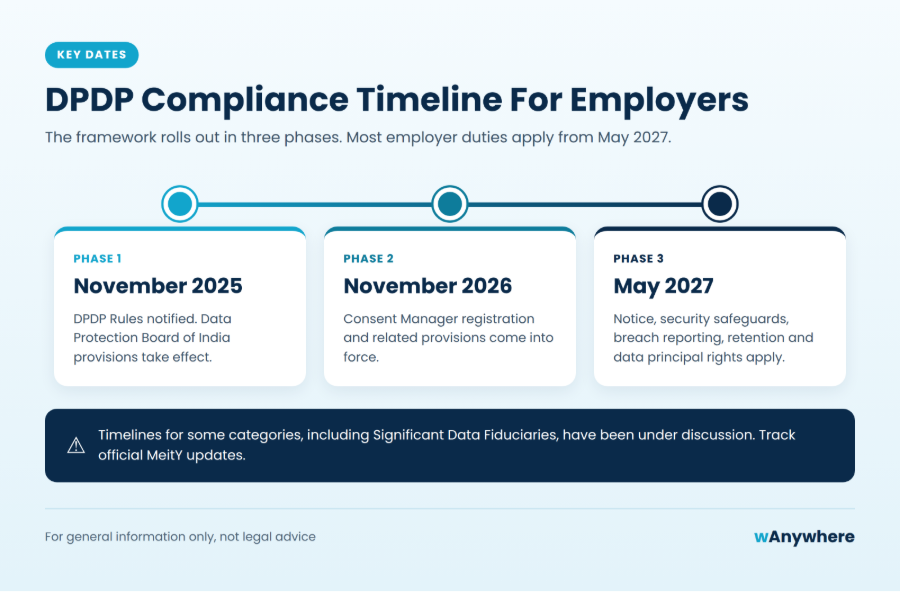
Employers should track official MeitY updates, since timelines for some categories of organisations have been under discussion. In early 2026, MeitY consulted industry on shortening the compliance window for Significant Data Fiduciaries, so larger organisations in particular should plan as if their deadline could arrive sooner.
Also Read :A Security Checklist For Remote BPO Operations
How The Law Applies To Employee Data
Under the Act, personal data can be processed for a lawful purpose in two ways: with the individual’s consent, or for one of the “certain legitimate uses” listed in Section 7. For employers, one of those legitimate uses is especially important.
The Employment Legitimate Use Under Section 7(i)
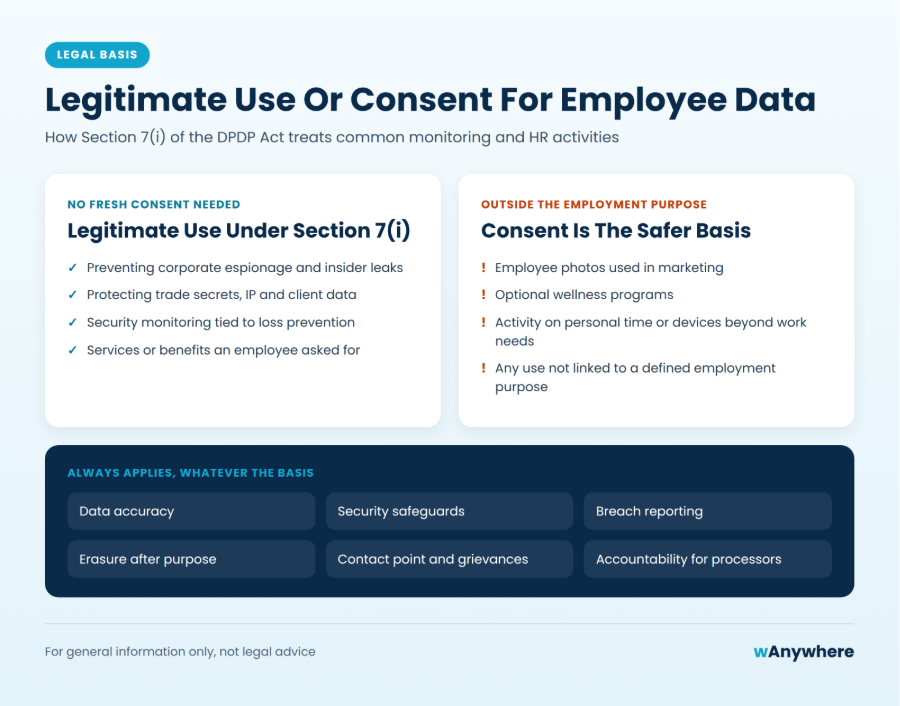
Section 7(i) permits processing for the purposes of employment, or to safeguard the employer from loss or liability. The Act gives examples such as preventing corporate espionage, maintaining the confidentiality of trade secrets, intellectual property and classified information, and providing services or benefits an employee has asked for.
This is significant for monitoring. A BPO protecting client card data, a bank preventing insider leaks, or an IT services firm guarding source code can rely on this provision to process relevant employee data without collecting fresh consent for every activity. The key word is relevant. The processing must genuinely serve an employment or loss-prevention purpose.
What Legitimate Use Does Not Excuse
Relying on legitimate use removes the consent requirement, not the rest of the law. Under Section 8, an employer acting as a fiduciary remains responsible for keeping data accurate when it is used to make decisions about a person, protecting it with reasonable security safeguards, reporting breaches, erasing data once its purpose is served unless the law requires retention, publishing a contact point for questions and running an effective grievance mechanism. It is also responsible for everything its processors do on its behalf.
When Consent Still Matters
Some processing sits outside the employment purpose. Using employee photos in marketing, collecting data for an optional wellness program, or capturing activity on personal time or personal devices beyond what the work requires are examples where an employer should not assume legitimate use applies. Where consent is the basis, it must be free, specific, informed, unconditional and unambiguous, and employees must be able to withdraw it as easily as they gave it. Given the power imbalance in employment, consent should be treated carefully and documented well.
Also Read: HIPAA Compliant Monitoring Software And Why It Matters
What DPDP Compliance Means For Employee Monitoring
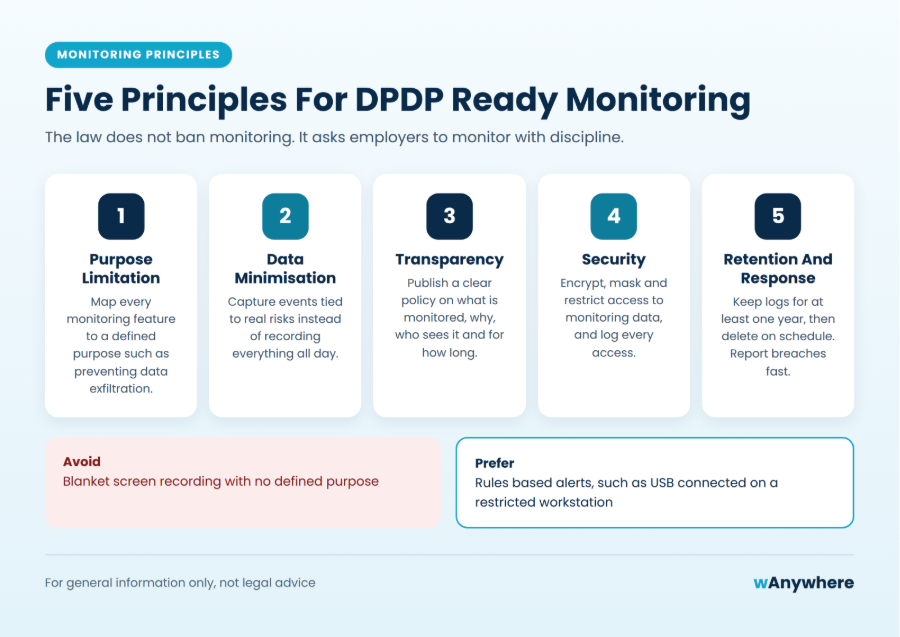
The framework does not ban workforce monitoring. It asks employers to monitor with discipline: for clear reasons, at a proportionate level, and with strong protection around the data collected. These are the areas where monitoring programs will need the most attention.
Purpose Limitation Shapes What You Monitor
Every monitoring activity should map to a specific purpose, such as preventing data exfiltration, enforcing clean desk policies on a payments floor, verifying that only authorised people are present at a workstation, or measuring time spent on client tasks. If a data point does not serve a defined purpose, collecting it creates risk without adding value.
Data Minimisation Over Blanket Surveillance
Collect what the purpose requires and nothing more. Detecting a USB device being connected to a workstation in a restricted process is very different from recording everything an employee does all day. Configurable, rules-based monitoring that captures events tied to real risks is far easier to justify than indiscriminate capture.
Transparency Builds Trust Even Where Notice Is Not Mandatory
The Act’s formal notice requirement is tied to consent requests, but transparency remains good practice for any monitoring program. A clear internal policy explaining what is monitored, why, who can access the data and how long it is kept reduces disputes, supports the legitimacy of the processing and helps employees exercise the rights they do have.
Security Of Monitoring Data Is Now A Legal Duty
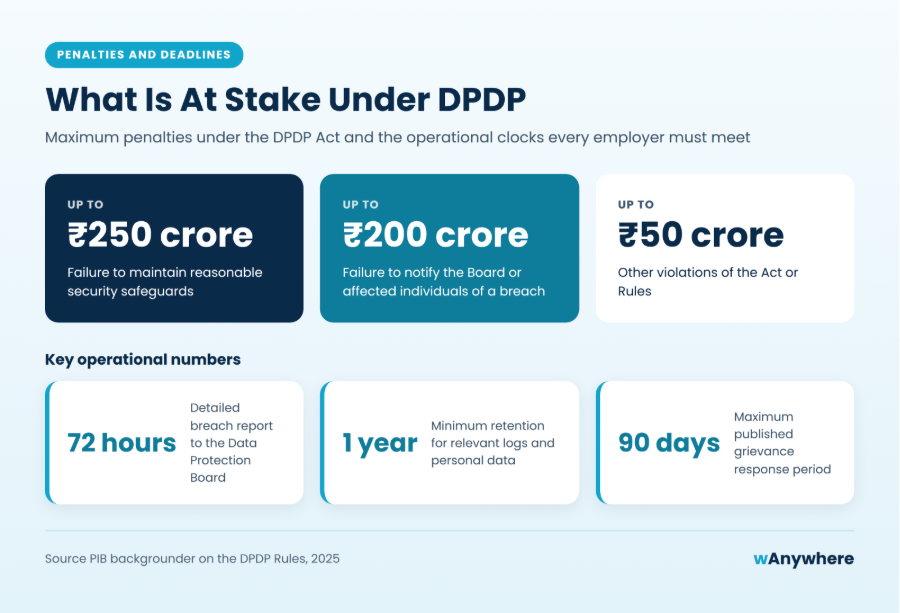
Monitoring systems hold some of the most sensitive data an organisation has, including screen captures that may show client information. The penalties for weak protection are steep. According to the Government of India’s PIB backgrounder on the DPDP Rules, failing to maintain reasonable security safeguards can attract a penalty of up to ₹250 crore, while failing to notify the Board or affected individuals of a breach can attract up to ₹200 crore, and other violations up to ₹50 crore.
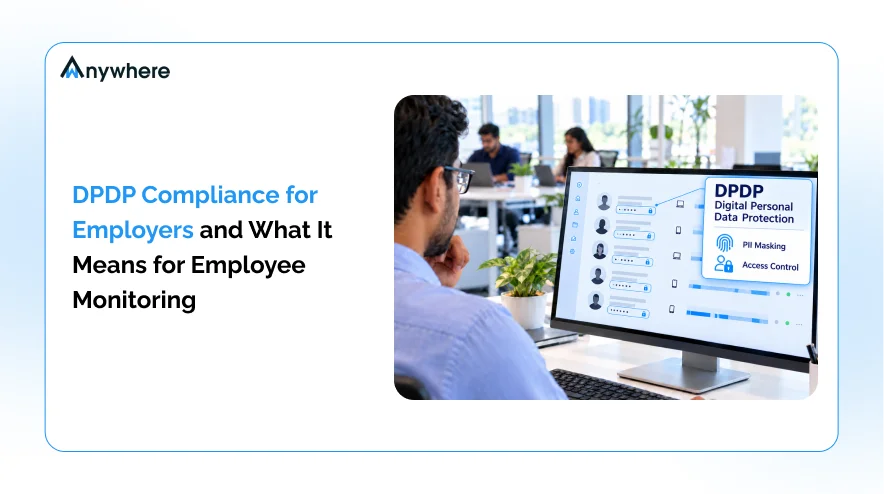
The Rules spell out minimum safeguards, including encryption, masking or tokenisation of personal data, access controls on computer resources, logging and monitoring of who accesses personal data, data backups for continuity, and security clauses in contracts with processors.
Logs, Retention And Breach Response
Two operational details in the DPDP Rules 2025 matter directly to monitoring teams. First, fiduciaries must retain relevant logs and personal data for at least one year to support the detection and investigation of unauthorised access. Second, after a personal data breach, they must notify affected individuals without delay and send the Board a detailed report within 72 hours of becoming aware of it, unless the Board allows more time. A monitoring platform that keeps clean, searchable records makes both duties far easier to meet.
Also Read: How AI Security And Compliance Tools Prevent Data Breaches In Real Time
Key Employee Data Protection Considerations For Employers
Getting ready for the new regime is less about one big project and more about a series of deliberate decisions. These are the considerations compliance managers, IT security leads and HR heads should work through together.
Map Every Employee Data Flow
Build an inventory of the employee data you hold, where it comes from, which systems store it, who can access it and which vendors touch it. Monitoring data should sit alongside HR, payroll and access control records in the same map, because a breach in any one of them carries the same consequences.
Define And Document The Purpose Of Each Activity
For every monitoring feature you use, write down the purpose it serves and the legal basis you rely on. This record becomes your strongest evidence if the Board or an employee questions the processing.
Review Contracts With Vendors And Processors
The Act holds the fiduciary responsible for processing done on its behalf. Contracts with monitoring, cloud and HR technology vendors should include clear security obligations, breach notification duties, limits on use of the data and requirements to erase data when the engagement ends.
Set Retention And Erasure Rules
Decide how long each category of monitoring data is genuinely needed, balance that against the one-year log retention baseline and any sector rules that apply to you, and automate deletion when the period ends. Data kept indefinitely is data you will have to protect indefinitely.
Publish A Contact Point And Grievance Process
Every fiduciary must publish business contact details for someone who can answer questions about how personal data is processed. The Rules also require a grievance redressal system with a published response period of no more than ninety days. Make sure employees know where to raise concerns about monitoring.
Train The People Who Access Monitoring Data
Team leads, quality analysts and security staff who review monitoring dashboards need to understand what they may use the data for and what they may not. Role-based access and regular training reduce the risk of misuse far more than policy documents alone.
A Practical DPDP Compliance Checklist For Monitoring Programs
Use this checklist to review your current monitoring setup against the framework’s core expectations.
- Every monitoring feature is linked to a documented purpose and legal basis
- Data collection is limited to what each purpose requires
- Employees have access to a clear monitoring policy
- Monitoring data is encrypted, access is restricted by role and every access is logged
- Logs are retained for at least one year and deleted on a defined schedule after that
- A breach response plan covers notifying employees without delay and the Board within 72 hours
- Vendor contracts include security, breach and erasure obligations
- A named contact and grievance process are published and tested
How wAnywhere Supports Compliance-First Employee Monitoring
wAnywhere is built for organisations where security and compliance come first and productivity insight is the supporting layer. That order of priorities fits naturally with what the new framework expects from employers.
Monitor What The Work Actually Requires
Section 7(i) recognises an employer’s need to guard against corporate espionage and protect trade secrets and confidential information. wAnywhere’s controls are designed around exactly those risks. USB and Bluetooth detection, SSID monitoring, copy-paste restriction, clean desk compliance and unknown person detection focus on specific, high-risk events rather than blanket recording, which helps teams keep monitoring proportionate and purpose-bound.
Visibility That Supports Security Safeguards
The Rules call for visibility into who accesses personal data, through logs, monitoring and review, so that unauthorised access can be detected and investigated. wAnywhere’s endpoint security and activity records give security leads the audit trail they need to spot incidents early and act quickly when the breach reporting clock starts.
Built For Regulated, High-Risk Operations
BPO floors, BFSI back offices and ITES delivery centres handle client data at scale, often under contractual and sector-specific security obligations on top of the new law. wAnywhere is designed for these environments, helping operations heads, IT security leads and compliance managers protect sensitive data while keeping teams productive. It also holds SOC 2 Type 2, ISO 27001, HIPAA and GDPR compliance badges, which supports the client audits these operations already face.
Make Privacy Part Of Your Monitoring Strategy
The new framework does not force employers to choose between security and privacy. It asks them to prove that their monitoring is necessary, proportionate and well protected. Organisations that treat DPDP compliance as a design principle, rather than a last-minute checkbox, will find it easier to defend their programs, retain employee trust and avoid penalties that could reach hundreds of crores.
Start now. Map your data, document your purposes, tighten access and retention, and choose monitoring tools that make employee data protection part of everyday operations.
Also Read: HIPAA Compliant Monitoring Software And Why It Matters
Get Ahead Of The May 2027 Deadline
See how wAnywhere helps employers run secure, purpose-driven workforce monitoring built for India’s new data protection rules.
Frequently Asked Questions
Do Employers Need Employee Consent For Monitoring Under The DPDP Act?
Not always. Section 7(i) allows processing for employment purposes and to protect the employer from loss or liability without consent. Monitoring that goes beyond those purposes may need consent, and every obligation around security, accuracy, breach reporting and erasure still applies.
Who Is The Data Fiduciary In Employee Monitoring?
The employer. It decides why and how monitoring data is processed, and it remains responsible for vendors that process the data on its behalf, such as monitoring software providers and cloud hosts.
When Do DPDP Compliance Obligations Take Effect?
The framework is being phased in. Board-related provisions took effect in November 2025, Consent Manager provisions follow in November 2026, and most substantive obligations, including security safeguards and breach reporting, apply from May 2027.
What Happens If Monitoring Data Is Breached?
The employer must inform affected employees without delay and notify the Data Protection Board, followed by a detailed report within 72 hours of becoming aware of the breach. Failing to notify can attract a penalty of up to ₹200 crore.
How Long Can Employers Keep Monitoring Data?
Personal data should be erased once its purpose is served, unless another law requires it to be kept. The Rules also set a baseline of at least one year for retaining relevant logs, so most organisations will need a documented schedule that balances both requirements.
Is Every Employer Treated As A Significant Data Fiduciary?
No. Only organisations the Central Government notifies, based on factors such as the volume and sensitivity of data processed and risk to individuals, carry the additional obligations of appointing a Data Protection Officer, conducting impact assessments and undergoing audits.

Table of Contents
Boost productivity and compliance with wAnywhere
Read summarized version with