

 Set as a preferred Google source
TL;DR
- Phone rules fail because they are written as bans, justified by distraction, and enforced by nobody in particular.
- Lead with the real reason. On most floors that is data protection and client obligation, not productivity.
- Use zones rather than one blanket rule, so the strictness matches the actual risk in each area.
- Keep the language narrow and specific. Broad conduct rules draw legal scrutiny in several jurisdictions.
- Roll it out with consultation, a grace period and visible enforcement from team leads, or it will quietly die within a month.
Most handbooks already have a phone rule in them. Walk any floor at two in the afternoon and you will see how much it is worth. Phones are face down beside keyboards, in laps, propped behind monitors, checked during the gap between one call ending and the next connecting.
The rule is not being defied. It is being ignored, which is a different and more awkward problem. A rule nobody follows and nobody enforces slowly teaches people that the handbook is decorative, and that lesson does not stay confined to phones.
Writing a better document is not the fix either. Plenty of organizations have a beautifully drafted cell phone policy that changes nothing, because the drafting was never the weak point. Organizations can also use mobile detection to identify phone usage during work hours and support consistent enforcement of workplace phone policies.
The short answer. A cell phone policy at work holds when it does three things. It explains the risk it is managing instead of asserting authority, it draws clear boundaries by place and situation rather than banning phones outright, and it is enforced consistently by the people who sit closest to the floor.

Know What Is Actually Happening On Your Floor
wAnywhere gives team leads visibility into workstation activity and policy violations, with evidence rather than guesswork.
What A Phone Policy Is Actually For
Before writing a word, settle the question the policy is answering. Most handbooks never do, which is why the resulting text sounds like a list of irritations.
There are four distinct reasons organizations restrict phones, and they call for very different rules.
| Reason | What It Protects | What The Rule Looks Like |
| Data protection | Customer records, credentials and documents on screen | Camera restrictions in areas where sensitive data is handled |
| Client obligation | Contractual and regulatory commitments to clients | Device free zones on specific accounts or queues |
| Safety | People working near machinery, vehicles or hazards | No handheld use during specific tasks |
| Focus and service | Call quality, response times and customer experience | No personal use while on a live interaction |
The first two justify strict rules and are easy to defend, because the reason exists outside the organization. The fourth is the weakest ground to build on, and it is the one most handbooks lead with. Telling adults that phones hurt their concentration invites an argument about whether that is true for them. Telling them a camera cannot be pointed at a screen holding a customer’s account number does not.
Why A Cell Phone Policy At Work Fails
The failures are predictable and they repeat across industries.
It Bans Instead Of Bounding
A blanket ban is the easiest thing to write and the hardest thing to sustain. People have children in school, elderly parents and appointments. A rule that ignores that is a rule people break with a clear conscience, and once they are breaking it for good reasons they stop distinguishing between good ones and bad ones.
It Gives A Reason Nobody Believes
Productivity is the most common justification and the least persuasive. Agents know they check their phones in the seconds between calls, and they know that is not what makes or breaks a shift. Using a reason the audience does not accept costs you credibility on every other rule in the document.
Nobody Owns Enforcement
Most policies say violations will be addressed without saying by whom. Team leads are not told it is their job, so they treat it as optional, and a rule enforced by some leads and not others is worse than no rule. It reads as favoritism.
It Was Written Without Asking Anyone
Rules drafted in a meeting room and announced by email arrive as something done to people. Rules shaped with input from the floor arrive as something agreed. The text can be identical and the outcome is not.
Also Read: How To Enforce A Clean Desk Policy In Your Business
The Four Zones Model
Rather than one rule for the whole organization, define zones and let the risk in each decide how strict it is. People accept uneven rules when they can see why the areas differ.
| Zone | Where It Applies | The Rule | Why |
| Restricted | Payments, healthcare and high sensitivity queues | Phones stored outside the work area during shift | Client contracts or regulation require it |
| Controlled | General production floors with customer data on screen | Phones permitted, cameras not, no use during live interactions | Protects data without removing contact |
| Open | Breakout areas, canteens, corridors | Personal use permitted | People need a release valve |
| Personal | Remote and hybrid setups | No capture of work screens, no sensitive calls in shared spaces | Office controls stop at the door |
The Open zone is the part most organizations skip, and it is what makes the rest workable. If there is nowhere a phone may be used, the Restricted zone will be breached quietly instead of respected openly.
What To Put In The Policy
A company cell phone policy that people can follow is shorter than most. Nine sections cover it.
- Purpose. One short paragraph naming the real reason, in plain language.
- Scope. Who it applies to, including contractors, temporary staff and visitors.
- Zones. Where each level of restriction applies, described by place rather than by job title.
- Permitted use. What is allowed and when, including breaks and genuine urgency.
- Cameras and recording. Usually the strictest clause, and the one with the clearest justification.
- Company issued devices. How work phones differ from personal ones, since the two are often conflated.
- Emergencies. A stated route for family and school to reach someone quickly.
- Enforcement. Who checks, what happens on a first instance, and what escalation looks like.
- Review. A date when the policy will be revisited, so it does not calcify.
Section seven is the one that decides whether the rest is accepted. Give a desk number, a team lead’s line or a reception route, and the most common reason for breaking the rule disappears. Leave it out and the policy is asking people to choose between their job and their family, which is not a choice it will win.
A Template Is A Starting Point, Not An Answer
Downloading a cell phone policy template is a reasonable way to get a structure quickly. What it cannot do is name your zones, your clients’ contractual requirements or your regulatory position, and those are the parts that make a policy enforceable rather than decorative.
Writing Rules That Hold Up Legally
Workplace rules are not purely an internal matter, and broad conduct clauses attract more scrutiny than most handbooks assume.
In the United States, the National Labor Relations Board’s 2023 decision in Stericycle holds that a workplace rule may be unlawful if an employee could reasonably read it as discouraging them from exercising their rights under the National Labor Relations Act, even when the rule never mentions unions. That standard applies to union and non union employers alike. Fisher Phillips notes that no decision has overruled Stericycle and that employers should treat it as the governing standard until a new one is formally adopted.
The position is contested rather than settled. SHRM has reported that the NLRB’s General Counsel has asked the Board to overturn Stericycle, so the standard may shift. Drafting narrowly is the safer position either way, because a narrow rule is lawful under both the strict standard and any looser one that replaces it.
Three drafting habits follow from that, and they improve clarity even where the rule does not apply to you.
- Tie each restriction to a stated business reason, such as protecting client data, rather than to general conduct
- Restrict the narrowest thing that achieves the purpose, for example camera use in a specific area rather than all device use everywhere
- Avoid clauses that could read as limiting employees discussing pay, conditions or workplace concerns with each other
Rules elsewhere differ, and sector regulation may impose requirements of its own. Have the final wording reviewed by someone qualified in your jurisdiction. Nothing here is legal advice.
How To Roll It Out Without A Fight
The rollout decides adoption more than the wording does. Four weeks is usually enough.
- Week one. Ask before you write. Short conversations with team leads and a sample of agents about where phones genuinely cause problems and where a rule would be unreasonable.
- Week two. Share the draft and say what changed because of the feedback. Naming a specific change is what proves the consultation was real.
- Week three. Brief team leads separately. They need to know exactly what to do when they see a phone, because improvising in the moment is how inconsistency starts.
- Week four. Go live with a stated grace period. Reminders rather than consequences, so people can adjust before anything counts.
Ask → Draft → Brief The Leads → Go Live With A Grace Period
Skipping week three is the most common mistake. A policy is only as consistent as the least confident supervisor applying it.
Enforcement That Does Not Breed Resentment
Enforcement fails in one of two directions. Either nothing happens, or the first instance is treated as misconduct. Both end the same way.
Make The First Response Quiet And Immediate
A short word at the desk, in the moment, handles almost everything. It costs nothing, it is not humiliating, and it establishes that the rule is live. Letting three instances pass and then raising it formally feels like entrapment, and it is.
Apply It To Everyone Visibly
A manager scrolling at a desk inside a Controlled zone destroys more compliance than a dozen agents doing the same. Seniority is the fastest way to make a rule look optional.
Separate Carelessness From Risk
Checking a message between calls and photographing a screen holding customer data are not the same act and should not carry the same response. Collapsing them into one offence makes the serious one look trivial.
Watch For The Rule Causing The Problem
If an entire team keeps breaking the same clause, the clause is usually wrong. Patterns in user behavior and endpoint activity tend to show this before anyone reports it, usually because the approved workflow is missing something people need.
Special Cases On Regulated Floors
Outsourced, financial services and healthcare operations face a stricter version of this question, because the restriction is often contractual rather than discretionary.
- Client contracts may specify device free floors for particular accounts, with audit rights attached
- Payment card environments typically restrict anything capable of capturing cardholder data
- Healthcare queues carry obligations around patient information that apply to a photograph exactly as they apply to a file
- Shift patterns mean one workstation passes between several people, so storage arrangements have to work at handover
- Hybrid agents sit outside every physical control, which is where written rules do most of their work
On these floors the policy is part of what the client is buying. That is worth saying plainly in the purpose section, because it moves the rule from company preference to shared obligation, and people treat the two differently.
Prove Your Controls, Do Not Just Document Them
Endpoint monitoring, camera based checks and audit ready records in one AI security and compliance platform.
How wAnywhere Supports Phone Restrictions
A written rule covers intent. Evidence covers everything else, which matters when a client auditor asks how the restriction is actually enforced rather than how it is worded.
Within its AI security and compliance platform, wAnywhere supports the enforcement side of a phone restriction:
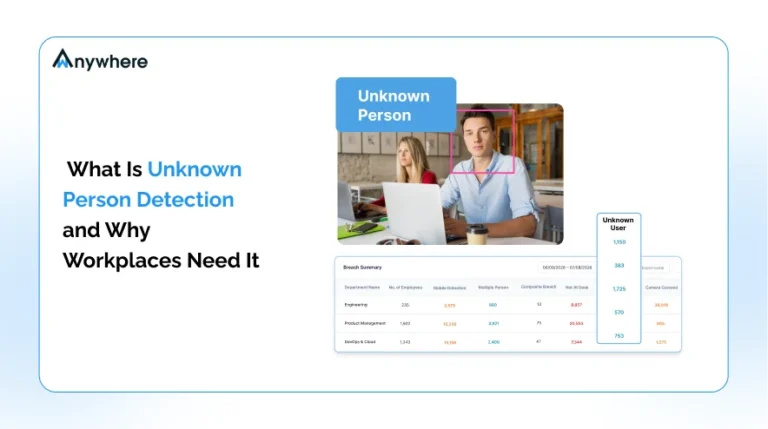
- Camera based checks that flag mobile phone use, an unknown person or multiple people at a workstation
- Screenshot and screen recording controls, so a captured screen is logged rather than invisible
- Department and process level policies, so a Restricted queue runs tighter rules than a Controlled one
- Automated responses such as screen blackout, manager alerts and violation triggered screenshots
- Audit ready records with reports and API access, which is what a client audit actually asks to see
The data protection side matters just as much as the detection side. Masking of confidential PII and PHI reduces what a photograph could capture in the first place, which is a stronger control than catching the photograph after it happens.
Also Read: Copy Paste Detection Software For Remote Data Security
Closing Thoughts
The difference between a rule people follow and one they ignore is rarely the wording. It is whether the reason is honest, whether the boundaries match the actual risk, whether there is somewhere a phone may legitimately be used, and whether the same standard applies to everyone on the floor.
Write it short. Name the real reason. Draw the zones. Say who enforces it and what happens first. Give people a route for genuine emergencies. Then review it after three months and change whatever is not working, because the clause everyone breaks is usually telling you something true.
Frequently asked questions
Can An Employer Ban Phones Completely
In most places yes, provided the restriction serves a genuine business purpose and is applied consistently. Total bans are harder to sustain in practice, and they work best when limited to specific zones rather than applied site wide.
Why Do Most Phone Rules Get Ignored
Four reasons. The rule bans rather than bounds, the stated reason is one nobody believes, nobody owns enforcement, and the floor was never consulted.
Should The Policy Say Phones Hurt Productivity
Avoid it. Productivity is the weakest justification and the easiest to argue with. Data protection and client obligation are stronger because the reason comes from outside the organization.
Is A Downloaded Template Enough
As a structure, yes. As a finished policy, no. A template cannot define your zones, your clients' contractual requirements or your regulatory position, and those are what make it enforceable.
How Do You Handle Family Emergencies
Give a named route. A desk number, a team lead's line or a reception contact that family and schools can use. Without it the policy loses every time.
Who Should Enforce It
Team leads, in the moment, with a quiet word at the desk. Escalate only on repetition or where data was genuinely at risk. Managers must follow it visibly or it collapses.
Are There Legal Limits On How It Is Written
Yes, and they vary by jurisdiction. In the United States, broad conduct rules face scrutiny under the NLRB's Stericycle standard. Keep restrictions narrow and tied to a stated business reason, and have the wording reviewed locally.
How Often Should It Be Reviewed
Set the first review at three months, then annually. If one clause is breached far more than the rest, treat that as a design fault rather than a discipline problem.

Table of Contents
Boost productivity and compliance with wAnywhere
Read summarized version with