

 Set as a preferred Google source
TL;DR
- India’s DPDP Act, 2023 and the DPDP Rules, 2025 require organizations to protect digital personal data through reasonable safeguards, accountable processing, and breach response processes.
- For BPOs, contact centers, and distributed teams, compliance depends on everyday workplace controls, not just a privacy policy.
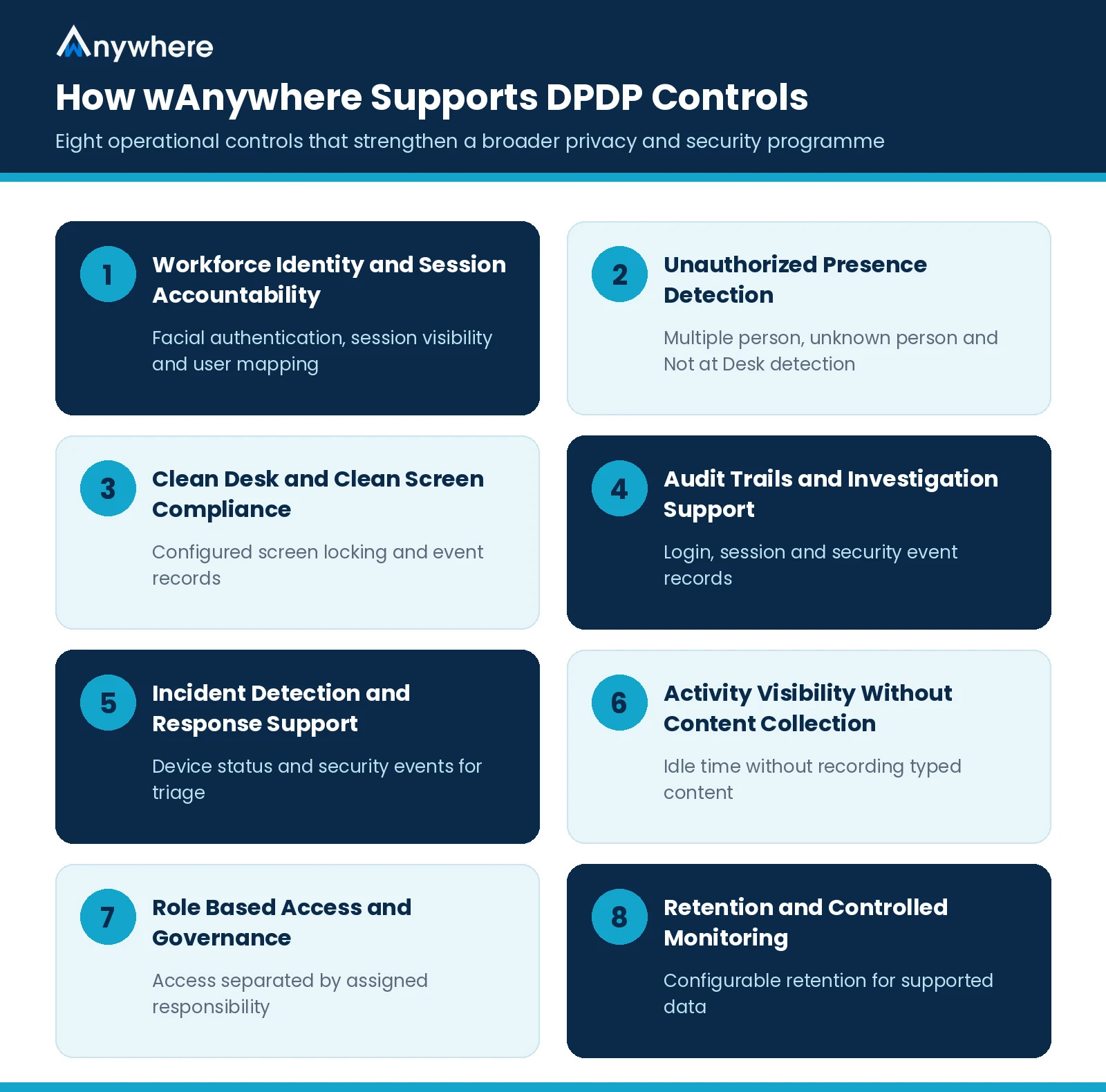
- wAnywhere supports eight operational controls, including identity checks, unauthorized presence detection, clean screen enforcement, event records, role-based access, and retention settings.
- wAnywhere strengthens your DPDP programme but does not certify compliance, so pair it with documented policies, incident response, and legal review.
Protecting personal data in the modern workplace requires more than a privacy policy. It requires visibility, security controls, accountability, and consistent operational practices.
Data Privacy Is Now an Operational Priority
As organizations embrace digital transformation, remote work, hybrid operations, and large-scale outsourcing, personal data is processed across an increasingly complex ecosystem of employees, systems, devices, service providers, and business applications.
For Business Process Outsourcing (BPO) companies, contact centers, IT-enabled services, and organizations managing distributed workforces, the challenge is particularly significant. Employees may access customer records, personally identifiable information, financial details, and other sensitive information while working across multiple shifts, locations, and endpoints.
India’s Digital Personal Data Protection Act, 2023 (DPDP Act) establishes a legal framework for the processing of digital personal data. The Digital Personal Data Protection Rules, 2025, further specify important operational requirements, including safeguards for personal data, breach-related notifications, and the handling of personal data in accordance with applicable obligations. The Act and Rules have a phased commencement framework, so organizations should assess which provisions apply to them and when. Official DPDP Act | DPDP Rules, 2025
Compliance is therefore not just a legal or IT responsibility. It must also be reflected in day-to-day workplace operations, access practices, security controls, incident response, and employee accountability.
This is where wAnywhere, ShepHertz’s workforce intelligence and security platform, can help organizations strengthen the operational controls that support their DPDP compliance programme.

See How wAnywhere Strengthens Workplace Security for DPDP Readiness
Identity checks, clean screen controls, and security event visibility for BPOs, contact centers, and distributed teams.
Understanding the DPDP Act Through a Workplace Lens
The DPDP framework places responsibilities on Data Fiduciaries and establishes obligations concerning the processing and protection of digital personal data. Organizations must evaluate their roles, purposes of processing, applicable legal requirements, and relationships with Data Processors.
In practical terms, organizations should consider five important questions:
- Who has access? Can access to systems and information be restricted to authorized users?
- What happens at the endpoint? Are appropriate controls in place when an employee leaves a workstation or an unauthorized person approaches?
- How is compliance demonstrated? Can the organization produce reliable records to support an internal review or investigation?
- How are incidents identified? Can suspicious activity and potential security-control failures be detected and investigated?
- How is personal data handled? Are monitoring practices proportionate, transparent, purpose-limited, and governed by appropriate retention policies?
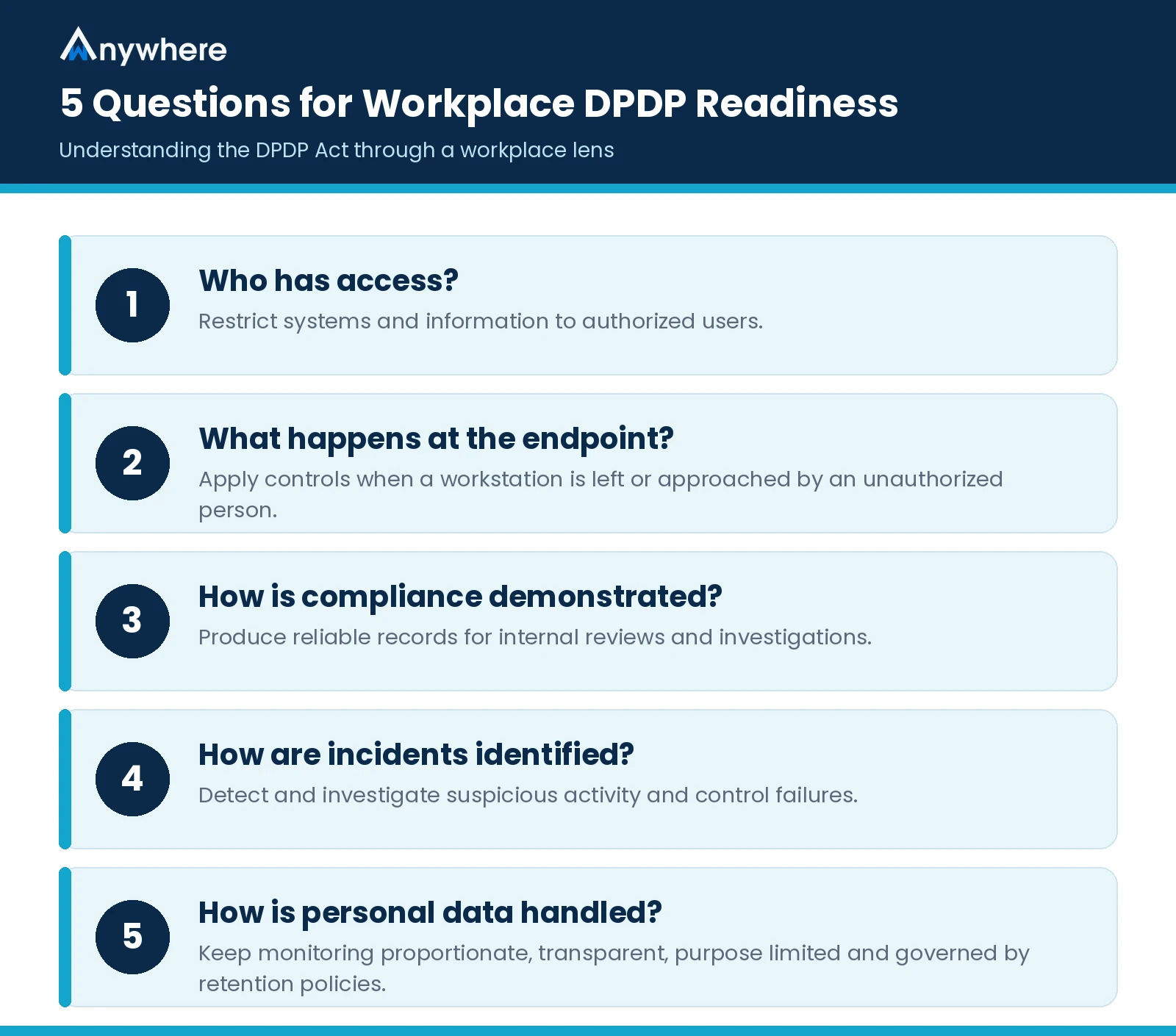
These questions are particularly relevant to BPOs and contact centers, where customer information may be accessed by thousands of employees across multiple teams and shifts.
Also Read: How AUX Time Tracks the Work Status of Remote BPO Agents
How wAnywhere Supports DPDP-Related Operational Controls
wAnywhere helps organizations establish visibility into workforce activity and strengthen endpoint-level security practices. Its capabilities can support a broader privacy and information-security programme, subject to configuration, deployment, organizational policies, and applicable legal requirements.
1. Workforce Identity and Session Accountability
The challenge: Organizations need to understand which authorized employee is associated with a workstation session and maintain accountability for access to business systems.
How wAnywhere helps:
- Facial authentication and identity-related checks, where configured.
- User login, logout, and session activity visibility.
- Support for mapping workforce activity to users, teams, departments, and managers.
- Configurable automatic-login workflows based on approved identity-matching criteria.
These capabilities can help organizations establish clearer accountability for workstation usage and investigate discrepancies in session activity.
For example, in a contact center, a properly configured identity-matching workflow can help verify that the employee associated with a wAnywhere account matches the intended endpoint identity.
DPDP relevance: These controls can support broader security and accountability measures. They do not replace application-level authentication, authorization, or access controls for customer databases and other business systems.
2. Unauthorized Presence Detection and Endpoint Protection
The challenge: An unattended workstation or an unauthorized person near an active session can expose customer information to inappropriate access.
How wAnywhere helps:
Depending on the modules and policies enabled, wAnywhere can provide:
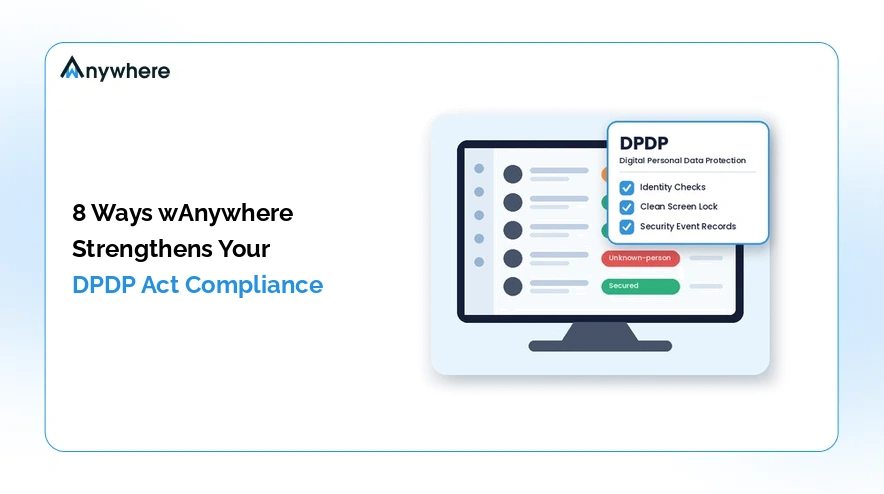
- Multiple-person detection.
- Unknown-person detection.
- Not-at-Desk detection.
- Configurable workstation locking or blocking actions.
- Security alerts and event records.
- Camera-status and device-availability monitoring to identify potential control failures.
For example, if an employee leaves an active workstation unattended, a configured Not-at-Desk policy can help identify the condition and trigger an appropriate response, such as locking the system.
Similarly, unknown-person or multiple-person detection can help security teams identify situations requiring investigation.
DPDP relevance: These capabilities can support endpoint security and reduce opportunities for unauthorized viewing or use of personal data. Their effectiveness depends on configuration, device compatibility, exception handling, and the organization’s overall security architecture.
Also Read: Copy Paste Detection to Control Malicious Intent and Protect Data Security
3. Clean Desk and Clean Screen Compliance
The challenge: Data exposure does not always result from a sophisticated cyberattack. It can occur when customer information remains visible on an unattended screen or when unauthorized individuals can view an active workstation.
For BPOs and contact centers, clean desk and clean screen practices are important components of operational security.
How wAnywhere helps:
- Monitor configured workforce and workstation security events.
- Identify Not-at-Desk conditions and associated session activity.
- Trigger configured screen-locking or security actions.
- Record relevant events for subsequent review.
- Support team-level and manager-level visibility into recurring control issues.
Organizations can use these capabilities to reinforce clean screen policies and identify recurring situations where additional employee training or stronger endpoint controls may be necessary.
DPDP relevance: Clean screen practices can help reduce accidental disclosure of personal data. However, a workforce monitoring platform alone cannot establish compliance with every requirement of the DPDP framework.
4. Audit Trails, Event Visibility, and Investigation Support
The challenge: When a security concern arises, organizations need reliable information to understand what happened, when it happened, which user or endpoint was involved, and what corrective action was taken.
How wAnywhere helps:
The platform’s workforce activity and security-event capabilities can support operational reviews through:
- Login and logout records.
- User activity and session information.
- Configured privacy-breach or security-event records.
- Camera and device-status events.
- Not-at-Desk and other enabled security events.
- Organizational dashboards and reports for authorized reviewers.
Consider a situation in which a contact center reports that a workstation was left unattended during a customer interaction. Relevant session and security-event records can help the organization reconstruct the timeline, investigate the circumstances, and determine whether further action is required.
DPDP relevance: These records can support internal investigations, security reviews, and evidence gathering. They should not be described as a complete statutory audit trail of all personal-data processing, because wAnywhere does not automatically record every database access, data transfer, consent event, or application-level operation.
5. Security Incident Detection and Response Support
The challenge: Organizations need to identify potential security incidents, assess their impact, take corrective action, and meet applicable breach-reporting obligations.
How wAnywhere helps:
Configured security events, device-status indicators, session records, and available reporting capabilities can help security and operations teams investigate endpoint-related concerns.
For example, a camera disconnection, an unexpected user-presence event, or a workstation security-control failure may warrant investigation, depending on the circumstances and the organization’s policies.
These records can contribute to incident triage by helping teams understand the endpoint conditions surrounding a reported event.
DPDP relevance: Under the applicable DPDP requirements, breach response may include notification to affected individuals and the Data Protection Board of India within the prescribed timelines. wAnywhere can contribute supporting operational information, but organizations must maintain a separate, documented incident-response process to assess whether a personal data breach has occurred and complete the required notifications.
Also Read: What Can Employee Monitoring Software Do for Your Organization
6. Workforce Activity Visibility Without Unnecessary Content Collection
The challenge: Organizations need operational visibility while respecting employee privacy and avoiding the unnecessary collection of personal information.
Excessive monitoring can introduce its own privacy risks if organizations collect more information than is necessary for a defined purpose.
How wAnywhere helps:
Depending on configuration, the platform can provide workforce activity information such as:
- Login and logout times.
- Idle time derived from keyboard and mouse activity, without recording the actual typed content.
- Application and website usage duration by name.
- Attendance and session information.
- Configurable security-event monitoring.
For example, an organization may be able to assess workforce attendance and idle periods without collecting the contents of every keystroke.
Organizations can also establish policies governing the activation of screenshots, recordings, and other higher-impact monitoring features.
DPDP relevance: Purpose limitation, data minimization, transparency, and retention governance should guide the organization’s monitoring design. Even metadata, application names, facial information, and workforce activity records may constitute personal data when they relate to an identifiable individual. Organizations should document the purpose and legal basis for processing, provide appropriate notices, restrict access, and periodically review what they collect.
7. Role-Based Access and Governance
The challenge: Security and workforce information should not be accessible to every manager or employee. Excessive internal access can increase the risk of misuse or unauthorized disclosure.
How wAnywhere helps:
Its supported role-based access controls can help organizations separate access according to assigned responsibilities, such as:
- Administrators responsible for platform configuration.
- Managers responsible for their teams.
- Auditors or authorized reviewers responsible for examining relevant records.
- Other authorized users with defined permissions.
Organizations can use these controls to limit access to workforce dashboards and relevant security information.
DPDP relevance: Access restrictions can contribute to broader organizational security safeguards. Organizations should also review identity management, privileged access, access revocation, encryption, backup protection, and other technical controls across the full technology environment.
8. Retention, Data Governance, and Controlled Monitoring
The challenge: Retaining information indefinitely can create unnecessary exposure, increase storage costs, and complicate privacy governance.
How wAnywhere helps:
Organizations can establish and review configured retention arrangements for supported categories of platform data, such as security events, screenshots, recordings, and application activity information, subject to the capabilities of their deployment.
For example, a company may define different retention periods for security-event records and optional recordings, based on documented business requirements and applicable obligations.
DPDP relevance: Retention periods should be determined by the specific purpose of processing and applicable legal requirements. Organizations should verify that deletion or erasure processes operate as intended, including across relevant backups and connected systems. A retention setting within wAnywhere does not automatically govern personal data held in customer applications, HRMS platforms, CRM systems, or other connected environments.
Also Read: Why Workforce Analytics Matters in the Remote Workplace
Mapping wAnywhere Capabilities to DPDP Compliance Priorities
| DPDP-related priority | How wAnywhere can contribute | What the organization must also do |
| Reasonable security safeguards | Endpoint security events, configured locking actions, identity-related checks | Implement comprehensive technical and organizational safeguards |
| Accountability | User, session, and security-event visibility | Define ownership, policies, and review procedures |
| Incident investigation | Relevant event records and reporting | Maintain incident assessment, escalation, and breach-notification processes |
| Purpose limitation and data minimization | Configurable monitoring and selective use of features | Document purposes, notices, and appropriate grounds for processing |
| Access control | Role-based access to supported platform information | Govern application access, privileged accounts, and access revocation |
| Retention governance | Configurable retention arrangements for supported data | Establish and validate retention and erasure policies across systems |
| Employee and customer privacy | Visibility into selected events without necessarily capturing typed content | Provide appropriate notices, restrict monitoring, and assess privacy impacts |
A Practical DPDP Readiness Approach for BPOs and Contact Centers
Technology is most effective when combined with clearly defined processes and responsibilities.
Organizations can use the following approach to strengthen their readiness.
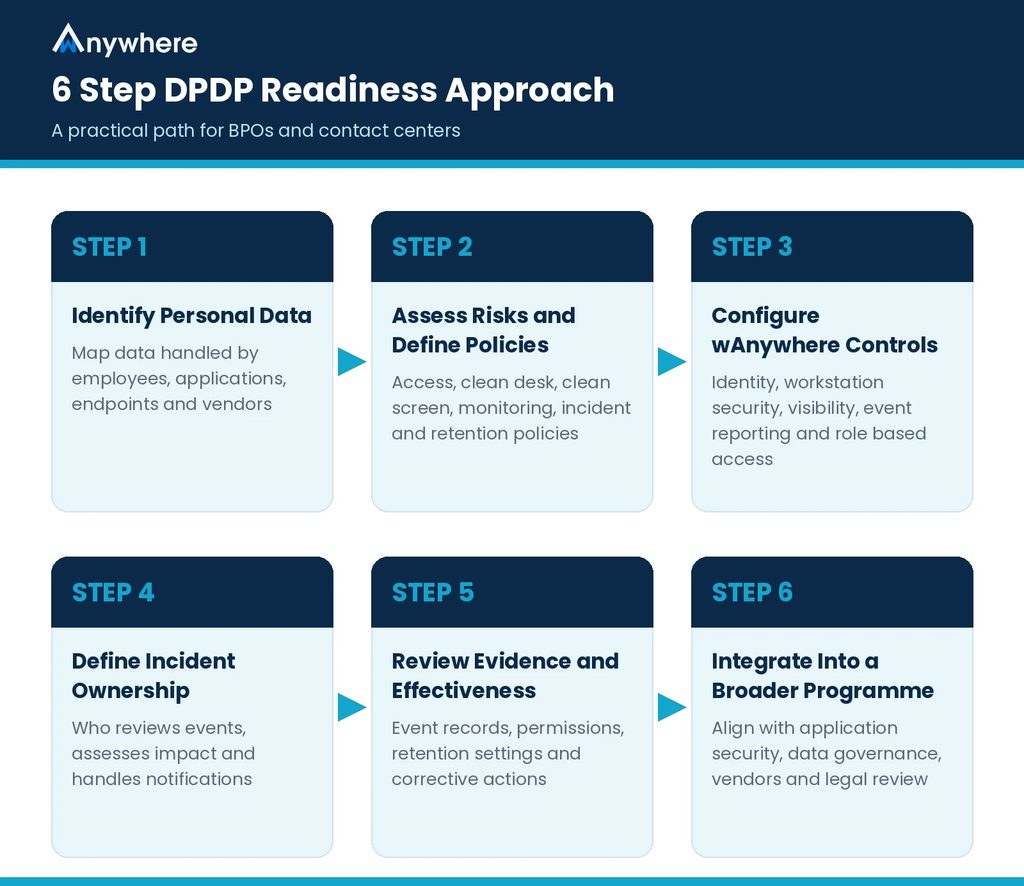
Step 1: Identify personal data and processing activities. Map the personal data handled by employees, applications, endpoints, vendors, and business processes.
Step 2: Assess risks and define policies. Establish access, clean desk, clean screen, endpoint security, employee monitoring, incident response, and retention policies.
Step 3: Configure the appropriate wAnywhere controls. Enable relevant identity, workstation security, activity visibility, event reporting, and role-based access features according to the organization’s requirements.
Step 4: Define incident ownership and escalation. Establish who reviews security events, who determines whether an incident involves personal data, and who is responsible for legal and regulatory notifications.
Step 5: Review evidence and effectiveness. Periodically assess event records, access permissions, retention settings, policy exceptions, and corrective actions.
Step 6: Integrate the platform into a broader compliance programme. Align endpoint controls with application security, data governance, vendor management, employee communications, and legal review.
Building a Culture of Data Responsibility Beyond Compliance
DPDP readiness should not be treated as a one-time technical implementation. It requires an ongoing commitment to responsible data handling.
For BPOs and contact centers, this means making privacy and security part of everyday work: ensuring that only authorized people access information, unattended sessions are addressed, security exceptions are investigated, and monitoring remains proportionate to its intended purpose.
wAnywhere can help organizations improve visibility into workforce operations and reinforce selected endpoint security controls. When deployed alongside appropriate organizational policies, legal processes, and technical safeguards, it can become a valuable component of a wider data protection strategy.
Build a Privacy Conscious Workforce With wAnywhere
Configure endpoint controls, role-based access, and retention settings that support your DPDP compliance programme.
Make Workplace Security Part of Your DPDP Strategy
The DPDP framework reinforces the importance of protecting digital personal data through appropriate safeguards and accountable processing practices.
For organizations managing large workforces, distributed teams, and customer-facing operations, achieving these objectives requires more than documentation. It requires effective controls that operate consistently in everyday workplace environments.
wAnywhere by ShepHertz helps organizations strengthen workforce accountability, endpoint security, clean screen practices, security-event visibility, and operational governance.
By integrating these capabilities into a broader privacy and information-security programme, organizations can build stronger foundations for protecting personal data, investigating security concerns, and demonstrating responsible operational practices.
Strengthen your workplace security. Improve operational accountability. Build a more privacy-conscious workforce with wAnywhere.
Disclaimer: This article provides general information and is not legal advice. wAnywhere supports selected operational security and governance activities but does not independently certify or guarantee compliance with the DPDP Act or the Digital Personal Data Protection Rules, 2025. Organizations should assess applicable provisions, commencement dates, product configurations, contractual obligations, and legal requirements with qualified privacy and legal professionals.
Frequently Asked Questions
Does wAnywhere Make an Organization DPDP Compliant?
No single platform can make an organization compliant. wAnywhere supports selected operational controls such as identity checks, endpoint security events, clean screen enforcement, role-based access, and retention settings. Organizations still need documented policies, notices, incident response processes, and legal review.
How Can BPOs and Contact Centers Reduce Personal Data Exposure at the Endpoint?
Combine clean desk and clean screen policies with configured controls such as Not-at-Desk detection, unknown person and multiple person detection, automatic workstation locking, and regular review of security events. Employee training and strong application access controls complete the picture.
Is Employee Monitoring Data Considered Personal Data Under the DPDP Act?
It can be. Metadata, application names, facial information, and workforce activity records may constitute personal data when they relate to an identifiable individual. Organizations should document the purpose of processing, provide appropriate notices, restrict access, and apply retention limits.
What Should an Organization Do if a Personal Data Breach Occurs?
Follow a documented incident response process to assess the event, contain it, and determine whether personal data was affected. Where the DPDP requirements apply, notify affected individuals and the Data Protection Board of India within the prescribed timelines. wAnywhere event records can support the investigation, but the notification decision rests with the organization.

Table of Contents
Boost productivity and compliance with wAnywhere
Read summarized version with