

 Set as a preferred Google source
TL;DR
Quick answer: in 2026, financial regulators around the world judge a breach by how quickly you detected it and what evidence you can show, not by the controls you bought. The key points:
- Reporting clocks for banks now run in hours, from one hour in Singapore and two hours in the Philippines to four hours under the EU’s DORA.
- Privacy regulators add their own deadlines, usually 72 hours, under rules such as GDPR and the Philippine Data Privacy Act.
- Almost every clock starts at awareness, so the moment you detect an incident is the moment you are measured from.
- Many BFSI leaks begin at the endpoint and with insiders, including offshore and outsourced teams, so network tools alone miss them.
- Auditors will ask for a timestamped chain from the first signal to every escalation decision.
- Strong BFSI data security compliance starts with detection that creates its own evidence trail.
Most banks and insurers don’t lose the regulatory argument because a breach happened. They lose it in the hours that follow, when an auditor asks a simple question: when did you first know? If the honest answer is “when a customer complained,” no policy document will save the review.
That is why data breach detection has moved from a SOC metric to a board-level compliance question. This guide explains what regulators now expect, which clocks start the moment you detect an incident, and how to build a detection setup that produces audit-ready evidence on its own.

Know The Moment Sensitive Data Starts Moving
wAnywhere flags USB transfers, screen captures, copy-paste of PII and unusual data activity across BFSI teams, with a timestamped audit trail ready for regulator and auditor reviews.
What Data Breach Detection Means For Banks, Lenders And Insurers
Data breach detection is the ability to spot, confirm and record unauthorised access to, or movement of, regulated data fast enough to contain it and report it within statutory timelines. In BFSI, that data means customer identity and KYC records, account and policy details, card data, credit histories and claims files.
This matters because nearly every reporting clock starts when you became aware, so the gap between the first suspicious activity and the first recorded awareness is exactly what an investigator examines. A bank that spots a leak on day two but cannot prove it has a weaker story than one that spots it on day three and logged every step.
The money follows the same logic. According to IBM’s 2026 Cost of a Data Breach Report, financial services breaches cost an average of $6.3 million, well above the global average. The same research found that organisations making extensive use of security AI and automation saved $1.93 million per breach compared with those using none. Faster, automated detection is a cost lever as much as a compliance win.
Also Read: How AI Security And Compliance Tools Prevent Data Breaches In Real Time
Why Detection Speed Now Decides Regulatory Outcomes
Older audits checked whether a control existed. Current frameworks check whether it worked, when it fired and who acted on it. Detection is the timestamp every other obligation is measured against.
The Clock Starts At Detection, Not At The Breach
Read the major reporting rules side by side and a pattern appears: the Bangko Sentral ng Pilipinas counts from discovery. GDPR counts from when the controller becomes aware. US federal banking regulators count from when the bank determines a notification incident has occurred.
Some teams read this as a reward for slow discovery. It isn’t. Investigators work backwards from logs, and if your systems raised an alert at 2 a.m. on Monday that nobody reviewed until Thursday, the regulator will treat Monday as the moment you knew.
Several Reporting Clocks Can Run At Once
A bank headquartered in one country, serving customers in another and running operations from a delivery centre in a third can face several deadlines from a single incident. The table below compares the clocks BFSI teams most often meet.
| Region | Rule | Who It Covers | Reporting Clock |
| Philippines | BSP Circular 1019 | BSP-supervised financial institutions | Initial report within 2 hours of discovery, follow-up within 24 hours |
| Philippines | Data Privacy Act and NPC Circular 16-03 | Personal information controllers | 72 hours from knowledge of a personal data breach |
| Singapore | MAS Notice on Technology Risk Management | Banks and other MAS-regulated institutions | 1 hour from discovery of a relevant incident |
| European Union | DORA | Banks, insurers, investment firms and payment institutions | Initial notice within 4 hours of classifying a major incident, and no later than 24 hours from awareness |
| EU and UK | GDPR | Any organisation processing personal data | 72 hours from awareness |
| United States | Computer-Security Incident Notification Rule | Banks supervised by the OCC, Federal Reserve and FDIC | 36 hours from determining a notification incident |
| United States | NYDFS Cybersecurity Regulation | New York-licensed banks and insurers | 72 hours from determining a reportable event |
| Australia | APRA CPS 234 | Banks, insurers and superannuation funds | 72 hours from becoming aware of a material incident |
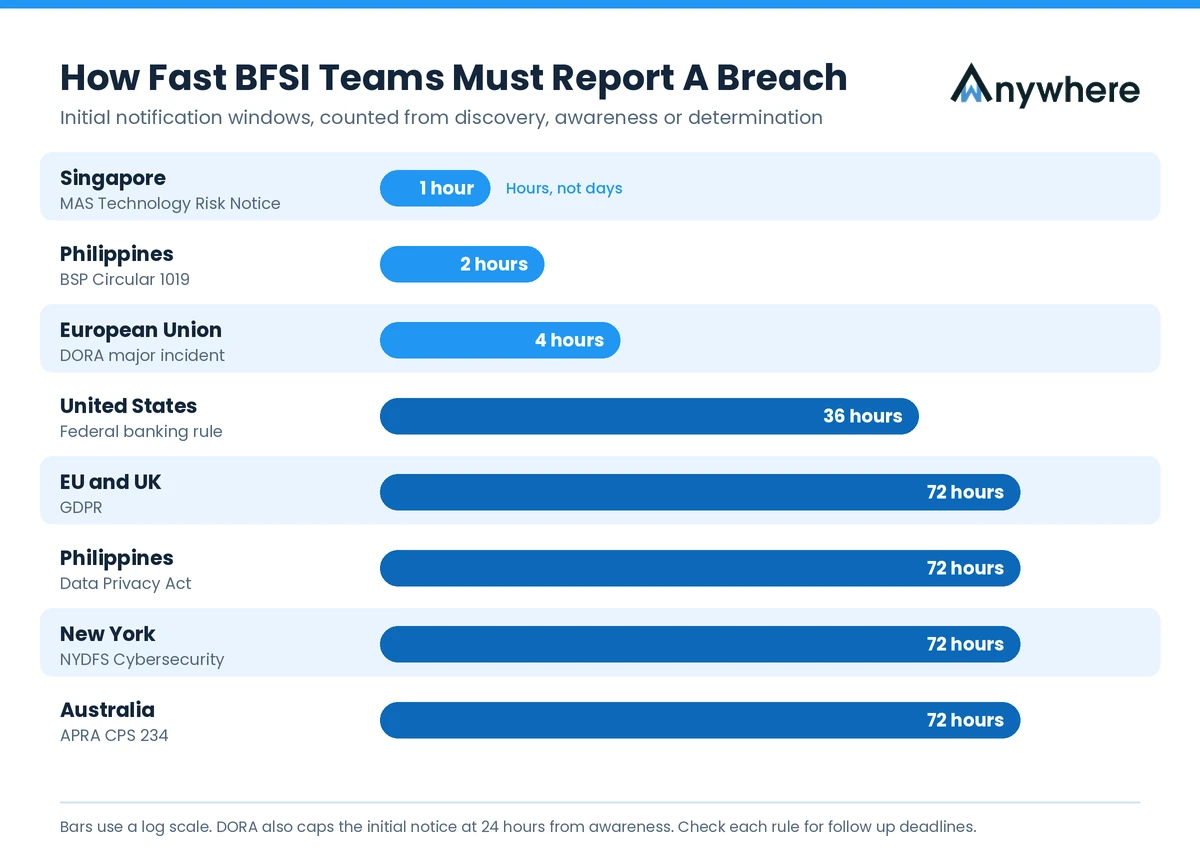
The practical risk is inconsistency. If one regulator hears the incident was contained at 4 p.m. and another later reads 9 p.m., you have a credibility problem on top of the breach. Mature teams keep one incident timeline and produce every regulator’s report from it.
What Changed Going Into 2026
Two shifts make this year different. First, DORA has applied across the EU since January 2025, so 2026 is the first full year in which supervisors are reviewing real incident reports and testing results against it. Second, attackers are moving faster. IBM’s 2026 research recorded a 56% rise in AI-driven attacks, led by deepfake impersonation and AI-enabled malware, which shortens the time between intrusion and data theft.
Regulators and attackers are compressing the timeline from opposite ends, and detection is the only part you control.
Where BFSI Breaches Actually Begin
Headlines focus on outside attackers, but many incidents at banks, lenders and insurers begin with someone who already has legitimate access. Think of a relationship manager in their notice period, a collections agent at an outsourced partner, or an analyst moving a report to a personal drive to finish it at home. These events rarely trip a firewall, because nothing about them looks like an attack to the network.
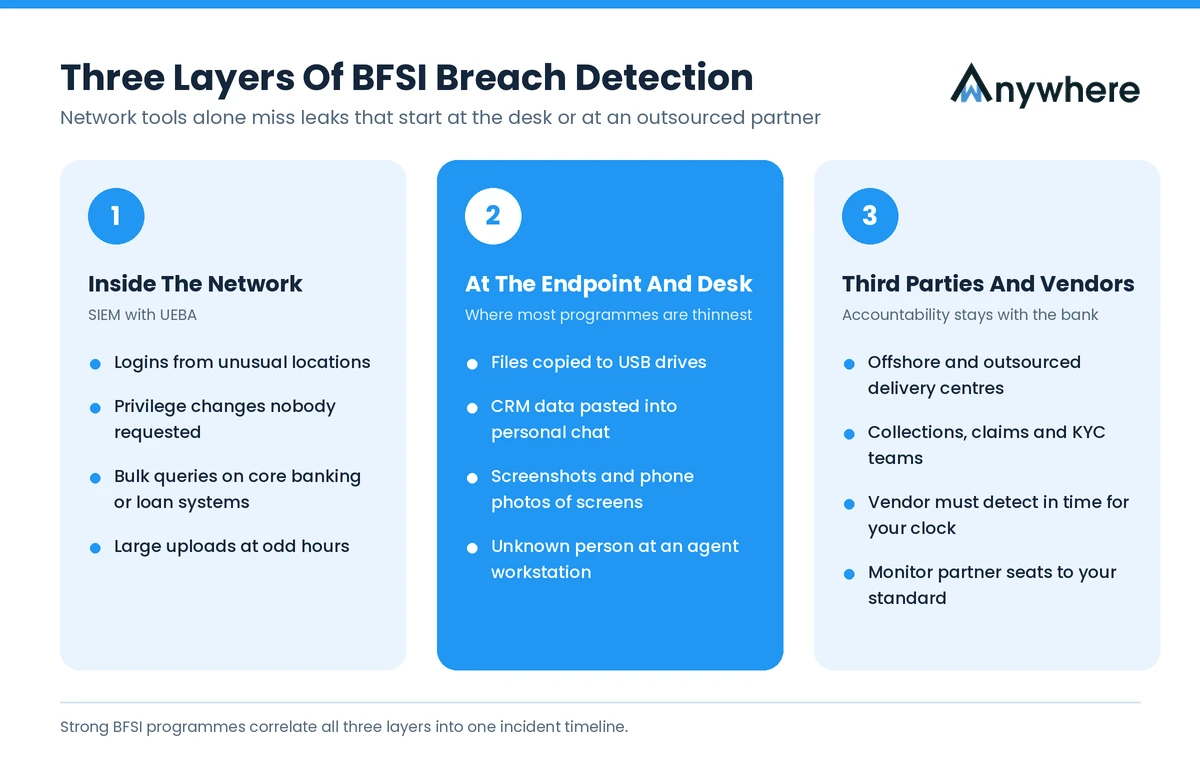
Detection in BFSI therefore needs coverage at three layers.
Signals Inside The Network
Network and application logs catch familiar patterns. Logins from unusual locations, privilege changes nobody requested, bulk queries against the core banking system or loan origination platform, and large uploads to web services at odd hours all belong here. A SIEM with user and entity behaviour analytics (UEBA) is usually the right home for these signals.
The weakness is context. A query that pulls 40,000 customer records looks identical whether it is a scheduled regulatory extract or an employee’s last week at the company.
Signals At The Endpoint And The Desk
This is where many BFSI programmes are thinnest. Common leak paths include files copied to USB drives, customer details pasted from a CRM into a personal chat window, screenshots of account statements, and photos of a screen taken on a mobile phone.
Physical signals matter too, especially in contact centres handling card and policy data. An unknown person at an agent’s workstation, a second face appearing on camera during a remote shift, or an agent walking away from an unlocked screen with customer data open are all early warnings. None of them reach a SIEM unless something at the endpoint records them.
Signals From Third Parties And Outsourced Teams
Global banks and insurers rely heavily on delivery centres in places like Manila, Cebu, Bengaluru and Kuala Lumpur for collections, customer service, claims and KYC verification. These teams handle regulated data every day, yet they sit outside the institution’s direct line of sight. Outsourcing rules in most markets, and DORA’s ICT third-party provisions in the EU, keep accountability with the financial institution rather than the vendor.
That only works if the vendor’s workforce is monitored to your standard. A vendor that cannot detect its own leak cannot report it to you in time for your clock.
Also Read : Insider Risks Vs Insider Threats
How To Build Detection That Holds Up In An Audit
Buying tools is the easy part. The harder work is making sure they produce a sequence of decisions an outsider can follow months later. These four steps address the gaps that typically surface in post-incident reviews.
Map Regulated Data To The People Who Touch It
Start with an inventory of where identity, card, account and claims data lives, then map which roles, teams and vendors can reach each store. Detection rules are only as sharp as this map. If you know a credit operations team never needs to export more than a few hundred records a day, an export of 20,000 becomes a clear signal rather than background noise.
Set Thresholds Before You Need Them
Define in advance what counts as a suspected breach, a confirmed breach and a reportable breach in each market you operate in, and write down who can make each call. Teams that settle these definitions mid-incident lose hours debating while a one-hour or two-hour window closes.
Thresholds should cover non-malicious events as well. Under GDPR and most modern privacy laws, an accidental disclosure such as a mis-sent email carrying customer data can be a personal data breach just as much as a hack.
Make Every Alert Produce Evidence
An alert that lives only on a dashboard is not evidence. Each detection event should capture who acted, on which device, at what time, against which data, and what happened next. Screenshots, file names, device identifiers and the reviewer’s decision belong in the same record.
Retention periods differ by market, so keep logs for as long as your strictest obligation requires. If you handle card data, PCI DSS already sets a floor of 12 months of audit log history, with the latest three months immediately available. This single habit separates audit-ready BFSI data security compliance from compliance that only exists on paper.
Rehearse The First Six Hours
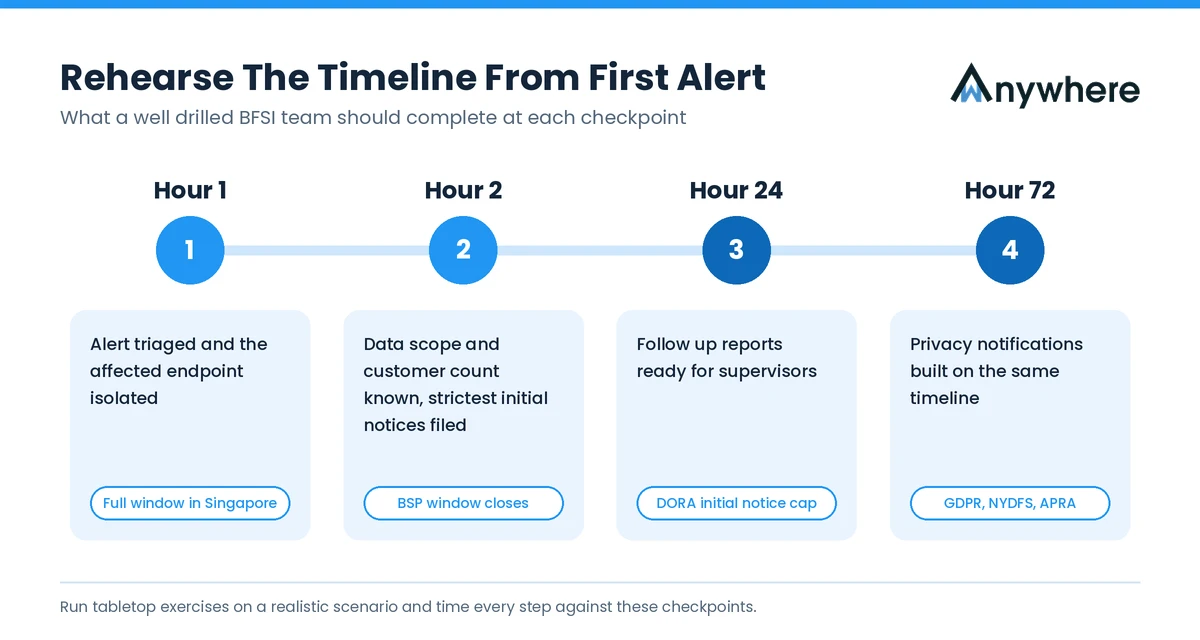
Run tabletop exercises around a realistic scenario, such as an offshore agent photographing customer card details, and time every step. Within the first hour, the alert should be triaged and the affected endpoint isolated, which is already the full reporting window in Singapore. By the second hour, the incident lead should know roughly what data is involved and how many customers it touches, and the strictest initial notices should be filed. Within 24 hours, follow-up reports should be ready, and the 72-hour privacy notifications then build on the same timeline instead of starting a new one.
Also Read: Endpoint Data Loss Prevention Guide
What Auditors And Regulators Will Ask To See
When an incident reaches review, expect questions about when the first suspicious activity appeared in your logs, when someone concluded that customer data was affected, what evidence supported that conclusion, and why notifications went out when they did. Reviewers will also check whether decisions were recorded as they happened or pieced together afterwards.
The most useful preparation is an evidence pack you could produce within a day. It should hold the detection alert and its raw log, triage notes with names and timestamps, containment actions taken on each device, the data scope assessment, copies of every regulator and customer notification, and the vendor’s own incident report if a third party was involved. Pair it with periodic board summaries, since DORA and most banking supervisors place final accountability for ICT risk on the board.
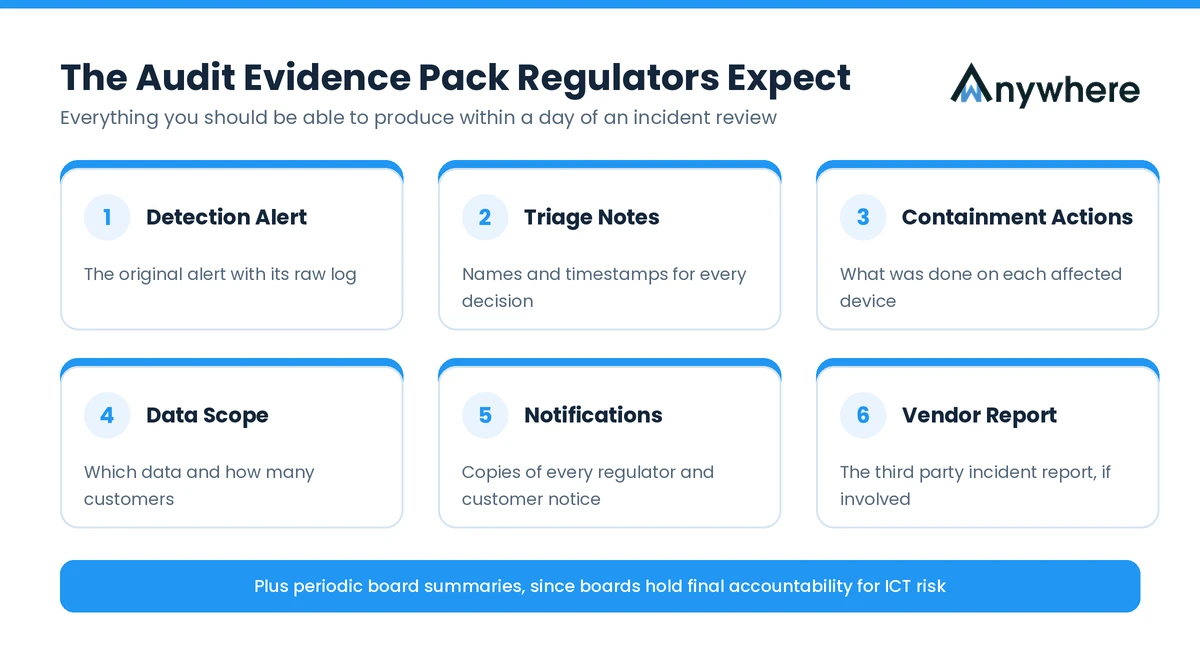
If any part of that pack depends on someone’s memory, fix that part first. BFSI data security compliance is, in the end, a record-keeping discipline as much as a technical one.
Also Read: How Security Leaders Can Reduce Audit Time And Maximize Compliance ROI
Where wAnywhere Fits In A BFSI Detection Stack
SIEM, DLP and EDR tools cover the network and the device. What they often miss is the person at the desk: the agent who photographs a screen, the shared login across a night shift, the stranger who sits down at an unlocked workstation. That workforce layer is where wAnywhere is built to work.
Its AI security and compliance suite combines data breach detection alerts with USB detection, copy paste restriction, mobile phone detection, unknown person detection and PII masking across in-office, remote and outsourced teams. Every event lands in a timestamped audit trail with screenshots and user context, which is the raw material for the evidence pack described above. Institutions using BPO partners can extend the same controls to partner workstations where contracts allow, giving them one view across every delivery centre.
The aim is not to replace your SOC but to give it, and your compliance team, the workforce-level records they lack. Book a demo to see how this maps to the reporting rules in your markets.
Turn Every Alert Into Audit Evidence
See how wAnywhere helps banks, lenders and insurers catch insider data risks early and keep a complete record for regulators and auditors in every market you operate in.
Building Breach Readiness Before May 2027
Reporting windows that used to be measured in days are now measured in hours, and attackers are speeding up at the same time. Firms that use the coming months to sharpen data breach detection, settle their thresholds and test their evidence trail across every market and delivery centre will walk into their next audit with a timeline instead of an apology.
Start with the endpoint and the insider, where most programmes are weakest.
Frequently Asked Questions
Does A Bank Need To Report To More Than One Regulator?
Often, yes. A single incident can trigger a banking supervisor's cyber reporting rule and a separate privacy notification, plus rules in every country where affected customers live. Running one internal incident timeline keeps those reports consistent.
What Counts As A Personal Data Breach?
Under GDPR and similar laws, it is any security incident that leads to accidental or unlawful destruction, loss, alteration, unauthorised disclosure of, or access to personal data. A mis-sent email with customer details can qualify, not only a cyberattack.
How Can Banks Detect Insider Data Theft?
By combining behaviour analytics in the SIEM with endpoint monitoring that records USB transfers, copy-paste of sensitive fields, screen captures and unusual export volumes.
What Are The Penalties For Missing A Breach Notification Deadline?
They vary by jurisdiction. Under GDPR, failures in security and breach notification can draw fines of up to €10 million or 2% of worldwide annual turnover, whichever is higher. Banking supervisors can add their own enforcement action on top.

Table of Contents
Boost productivity and compliance with wAnywhere
Read summarized version with